1300 364 277
Quick Exit
This button appears across the site. Press this button to exit the site immediately to nondescript link
Click to close or press

10 Tips for Your Online Counselling Session

Online therapy is a great way to get the support you need in the comfort of your own home.

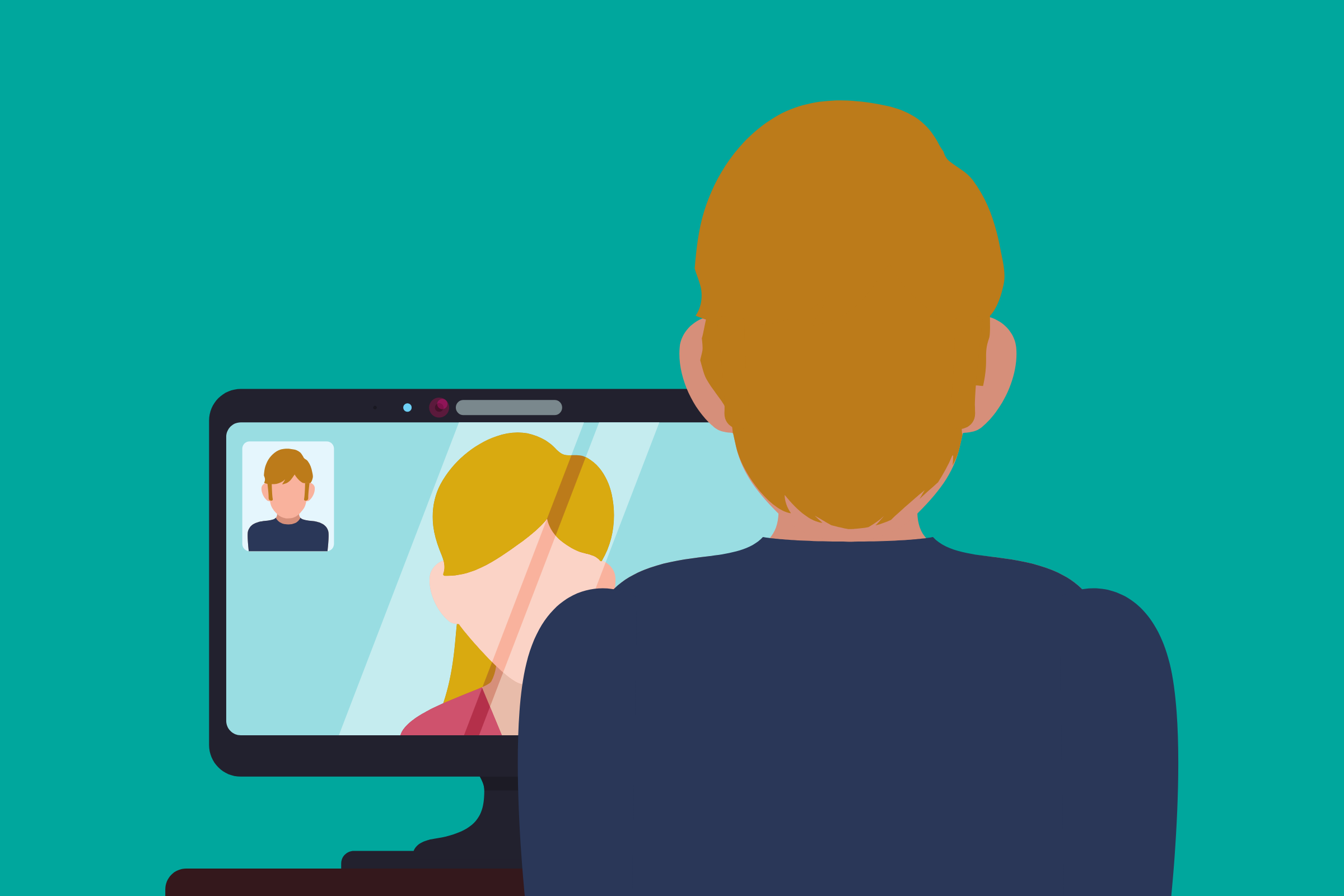
From Skype to Zoom, there are plenty of video conferencing platforms that make online counselling easy and convenient for anyone with an internet connection. But there are a few extra things to think about when preparing for your online counselling session.

Create a suitable environment and make the most of your online counselling sessions with these ten tips.


1. Give yourself time to set up

Allow at least 5-10 minutes to get set up before your session to avoid rushing to get ready at the last minute. This will allow you to test out your video and microphone and troubleshoot any technical difficulties without eating into your appointment time.


2. Ensure your internet is stable

A reliable internet connection is a must. If your Wi-Fi is patchy in certain parts of your house, try setting up next to the router to ensure a strong and fast connection.


3. Find a private room or space

Having someone else in the room might make it hard to concentrate or make you feel uncomfortable sharing certain things with your counsellor. Privacy is important, so find a quiet, private room or space for your online counselling session – and keep energetic cats and dogs out.


4. Get the lighting right

Your counsellor wants to see your face! Make sure there’s enough light to show your face on camera, and sit in the centre of the screen with your head and shoulders in the picture (like a passport photo). Natural lighting is best, but use lights and lamps to make yourself visible if need be.


5. Turn off ceiling fans

Ceiling fans can create a flickering effect on camera. It’s best to turn them off during your online therapy session.


6. Use earphones

Whether you have noisy neighbours, live near a busy road, or your partner likes to play the TV loud, background noises can be an unwanted distraction. Protect your concentration and use earphones or headphones to block background noise out.


7. Close other tabs

Having other internet programs open can chew up some of your internet and cause your system to slow down. Not to mention, notifications and alerts from Facebook and other sites can interrupt the flow of your conversation. Close other tabs or mute notifications before your session.


8. Make a list

If there are a few things you’d like to talk about in your online counselling session, it can help to write a list. You can refer to your list if you lose your train of thought or get interrupted by your child, partner, or pet.


9. Put your phone away

Phones are distracting even when they’re on silent. Remove the temptation to check your phone or watch notifications lighting up the screen by putting it in a cupboard or drawer until your session is over.


10. Have a backup plan

Technology doesn’t always work the way we want it to. It’s a good idea to have a plan B lined up just in case your online counselling session gets interrupted by a dodgy internet connection. You might like to take your session over the phone if this happens.


Bonus Tip: Take some time after your session

After face-to-face counselling, you’d normally have time on the trip home to think about the session. But with online counselling, it can be easy to immediately go back to your daily tasks. If you can, take some quiet time to reflect on the things you discussed and how you’re feeling.
You can learn about Relationships Australia QLD’s counselling service here, or call us on 1300 364 277 to talk to a professional counsellor over the phone or book your video counselling session. This number is available Monday-Friday 8am-8pm and Saturday 10am-4pm.

Coronavirus Disruption: A Counsellor’s Experience with Going Online

A lot has changed over the past few months. The coronavirus outbreak has impacted how we work, play, learn, and interact with one another.

Social distancing measures have forced some companies to close their doors, while others have had the chance to adjust their service delivery.

The coronavirus presented Relationships Australia QLD (RAQ) with the opportunity to fast-track the advancement of our online capabilities and continue to provide clients with the support they need.

Relationship Counsellor Shirley Hussie has been offering counselling sessions for individuals and couples over telephone and video chat. We asked her to share her experience with adapting to the disruption of COVID-19, and her advice for anyone considering online counselling.


Getting Up and Running

Shirley has been working from her home since Easter. Like many RAQ practitioners, she’s been providing counselling sessions via telephone and Zoom.

No one could have predicted the extent of the coronavirus crisis and how it would impact businesses so greatly, and Shirley praises RAQ for their rapid response.

“What they were able to accomplish in that first week was phenomenal with getting everyone set up to work remotely. Hats off to IT – they did an incredible job and were so helpful,” she says.

“The support that has been offered by Management has been extraordinary – that includes my Team Leader, Supervisor, and everyone up the line. I have felt so supported through the whole process, which has made the day-to-day challenges and changes easy and effortless.”

Shirley explains there were a few challenges at first, including feeling isolated and lonely without the face-to-face contact with other staff members. She also notes logistical bumps along the road.

“The initial challenge was gaining access to a computer and feeling comfortable and secure with using the technology – primarily Zoom. I used an older computer from the venue for the first week, after which time I was provided a brand new computer, which is fabulous,” she explains.

“RAQ offered loads of support around using Zoom and allowed plenty of time to become confident and competent with using it before going live with clients. I’m proficient with Zoom and love it now!”

Shirley commends her colleagues for being resilient, resourceful, and innovative, and continuing to provide quality services for clients during this time.

She thinks it’s important to embrace the changes caused by COVID-19, stating, “I believe the services provided to the clients via Zoom and telephone have been just as – if not more – powerful and transformative, as clients have the luxury of staying in the safety of their own home and don’t have to deal with the stress of childcare, traffic, or taking time off work. I would love to continue offering Zoom sessions once we return to the mothership.”

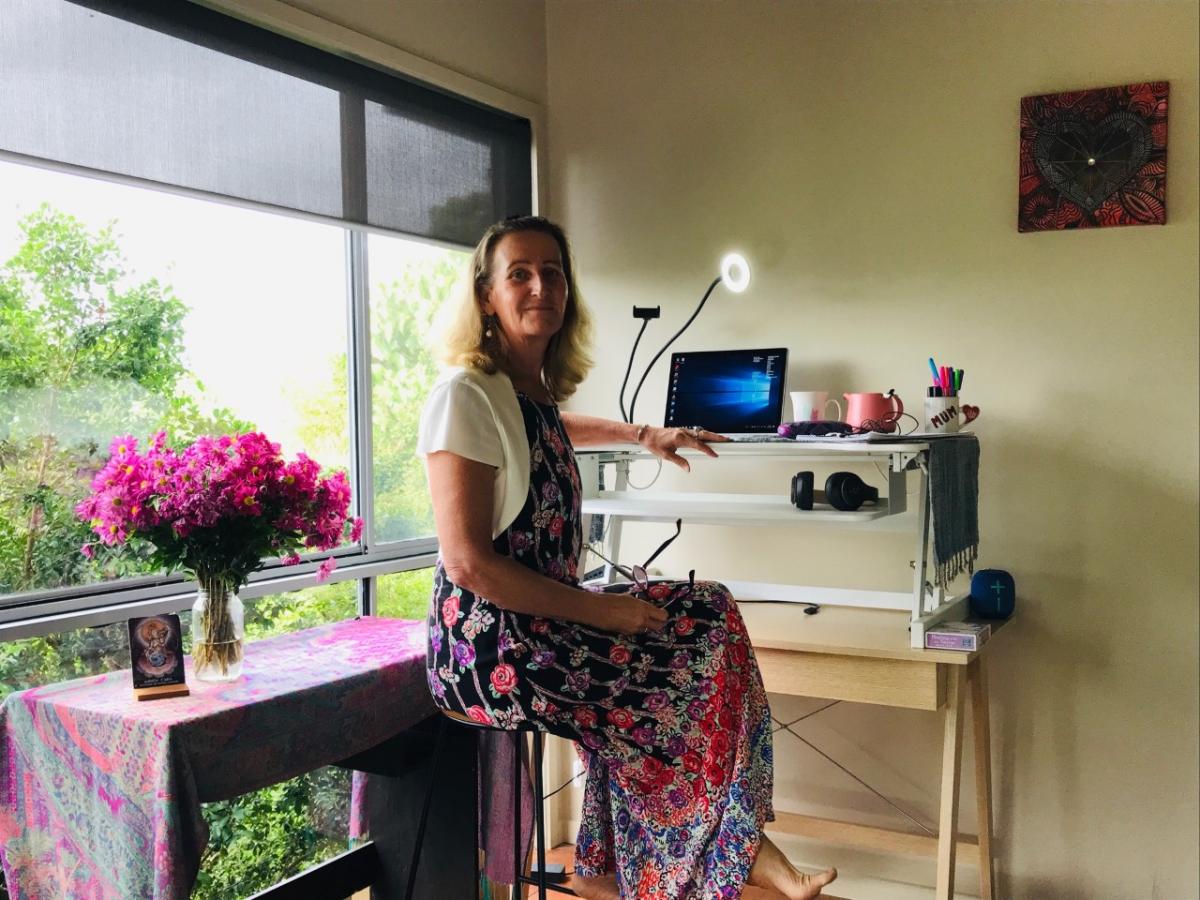
Relationships Australia QLD counsellor working from home in bright home office


Online Counselling Tips for Couples

Our telephone and video counselling is a service provided to individuals and couples who need support or just want to talk. If you’re considering online couples counselling, you might find Shirley’s advice helpful.

“In regards to couples work, I encourage clients to take the same amount of time that they would travelling to the venue to connect with each other prior to the session. I suggest they also spend some time together and have a cup of tea or go for a walk and talk after each session,” she says.

“Couples have reported really enjoying this time, and it shows them they can have ‘date nights’ or ‘date breakfasts’ in the comfort of their own home, and that ‘date nights’ don’t have to be an extravaganza or expensive.”

Shirley explains that having couples counselling from home can encourage ongoing conversation in that space.

“Having the session in the comfort of their lounge chair gives them a template/association to having deep and meaningful conversation from their lounge chair,” she explains.

“Just as they associate the counselling room with time spent talking about their relationship, they now have this association with their lounge chair. I think this is a very positive thing and will have ongoing profound beneficial impacts on the relationship by creating the memory of being able to have difficult or challenging conversations in the comfort and safety of their own home.”


Our Remote Counselling Services

You can access our remote counselling services in these easy steps:

  1. Phone the Client Contact Centre (Mon-Fri 8am-8pm, Sat 10am-4pm): 1300 364 277
  2. You’ll be booked in with a practitioner for an appointment over the phone or over video
  3. If you’re booked in over video, you’ll be emailed an invitation link to the Zoom session
  4. When you click the Zoom link at the approved appointment time, you’ll be admitted into your private Zoom room with your practitioner.


Been online more than ever during the coronavirus? Stay safe with our article How to Protect Yourself Online During the Coronavirus.

How to Support a Partner with Depression

Depression is a common and serious mental illness that impacts many Australians. Research shows one in seven Australians will experience depression in their lifetime.

Many people find themselves supporting a partner with depression at some point, and the condition can take a heavy toll on relationships. Relationships can be a lot of work even when both people are in a good mental space. Couples dealing with depression face their own daily challenges.

No one wants to see their partner suffer, and living with a partner with depression can cause loved ones to feel overwhelmed, helpless, and even afraid.

Support from friends and family plays an important role in treating or managing symptoms. If your partner suffers with depression, there are ways to help them on the road to recovery and nurture a healthy relationship.

If you are in an emergency or there is an immediate risk of harm to yourself or others, please call 000.


Learn About Depression

The first step to help a partner with depression is to increase your understanding of the condition.

Depression affects everyone differently, and symptoms can vary and change over time. Some signs your partner might have depression include:

  • Feelings of sadness, worthlessness, or guilt
  • Loss of interest or pleasure in activities they normally enjoy
  • Withdrawal from friends and family
  • Anxiety, agitation, or irritability
  • Changes in appetite or weight
  • Changes in sleeping habits
  • Fatigue and loss of energy
  • Difficulty thinking, concentrating, or making decisions
  • Thoughts of death or suicide.

There are plenty of reputable resources online that can help you learn about depression and mental health – such as these factsheets from Beyond Blue and SANE Australia – but the best way to understand your partner’s experience is to talk to them about it. Show an interest, listen with empathy, and ask open-ended questions such as:

  • Can you help me understand how you’re feeling?
  • What things do you find enjoyable at the moment?
  • What helped you the last time you felt this way?
  • What changes can help you feel better right now?
  • What do you need from me?


Be Patient and Understanding

It’s understandable to get upset from time to time, but it’s important to remember that depression is a mental illness. Your partner isn’t choosing to be ‘negative’ or ‘lazy’, and it’s not just a ‘bad mood’ that they’re experiencing. Getting frustrated with your partner for being sad, detached, or not wanting to get out and do things may exacerbate their symptoms and make them feel worse.

It can be especially hard to understand what your partner is going through if you haven’t experienced depression yourself. Try not to take it personally and remember depression is no one’s fault. A little patience and understanding can go a long way in making your partner feel loved and supported.


Don’t be a Cheerleader

It might be tempting to jump in and try to ‘fix the problem’ with positivity, but this can make people suffering with depression feel even more alone.

Trying to cheer your partner up with comments like “look on the bright side”, “it could be worse”, or “you don’t have anything to be depressed about” can invalidate their feelings and trivialise their condition, making them feel worse.

Again, depression is not a choice, and your partner cannot make the decision to ‘snap out of it’. If you don’t know what to say, try simply listening with empathy, holding their hand, and telling them you’re there to support them.


Focus on Small Goals

Small activities like getting out of bed or taking a shower can take an immense amount of effort for someone experiencing a severe depressive episode.

It might help to work with your partner to set small, achievable goals on these days (e.g. have a shower, get dressed, eat breakfast) or break down larger tasks (e.g. apply for a job) into several small tasks (e.g. update resume, write cover letter).

Acknowledge these little wins and continue to encourage your partner to take small steps in a healthy direction each day.


Create a Supportive Home Environment

While you can’t cure your partner’s depression, you can encourage them to make healthy choices that may have a positive impact on their symptoms.

You can help by:

  • Supporting them to have a healthy amount of sleep
  • Buying and cooking healthy meals together
  • Going for a walk or doing other exercise together every day
  • Continuing to do the activities you enjoy together
  • Providing emotional support and positive reinforcement.


Know the Warning Signs of Suicide

Some people with depression may be at risk of suicide. Seek immediate assistance if you recognise these warning signs:

  • Saying they feel worthless or alone
  • Feeling overwhelmed with hopelessness
  • Talking about death or wanting to die
  • Purchasing a gun or stockpiling pills
  • Extreme mood swings
  • Social withdrawal
  • Noticeable changes in normal daily routines
  • Uncharacteristically risky or self-destructive behaviour (e.g. drug or alcohol abuse or reckless driving)
  • Giving away sentimental or expensive possessions
  • Changes in personality and/or appearance
  • Saying goodbye
  • Getting affairs in order
  • Sudden calmness.

These are just some of the signs that someone might be suicidal. Use your gut instincts and take any red flag seriously.

If you think your partner might be suicidal, don’t be afraid to ask them directly. If they say yes, stay with them and listen to how they’re feeling, then get the appropriate help – such as calling the Lifeline crisis line on 13 11 14, or 000 if life is in immediate danger. Or you can see if you can get them an immediate appointment with a GP or psychologist.


Gently Encourage Them to Get Support

Depression is a real illness that requires treatment. If your partner’s symptoms are severe enough to impact their daily activities, work, and relationships, you can help them by gently encouraging them to seek professional help.

You might like to talk with them about treatment options (e.g. therapy, medication, and lifestyle changes) and let them know you’re there to help with making and preparing for appointments.

There are plenty of support services available for people experiencing depression. Relationships Australia Queensland provides free over-the-phone counselling for anyone who needs support. You can call us on 1300 364 277 Monday-Friday 8am-8pm and Saturday 10am-4pm.


Look After Yourself, Too

Caring for someone with depression can be challenging, so don’t forget to take care of your own mental and emotional health.

Our over-the-phone counsellors are available to talk if you need some emotional support, too: 1300 364 277.

If you are in an emergency or there is an immediate risk of harm to yourself or others, please call 000.


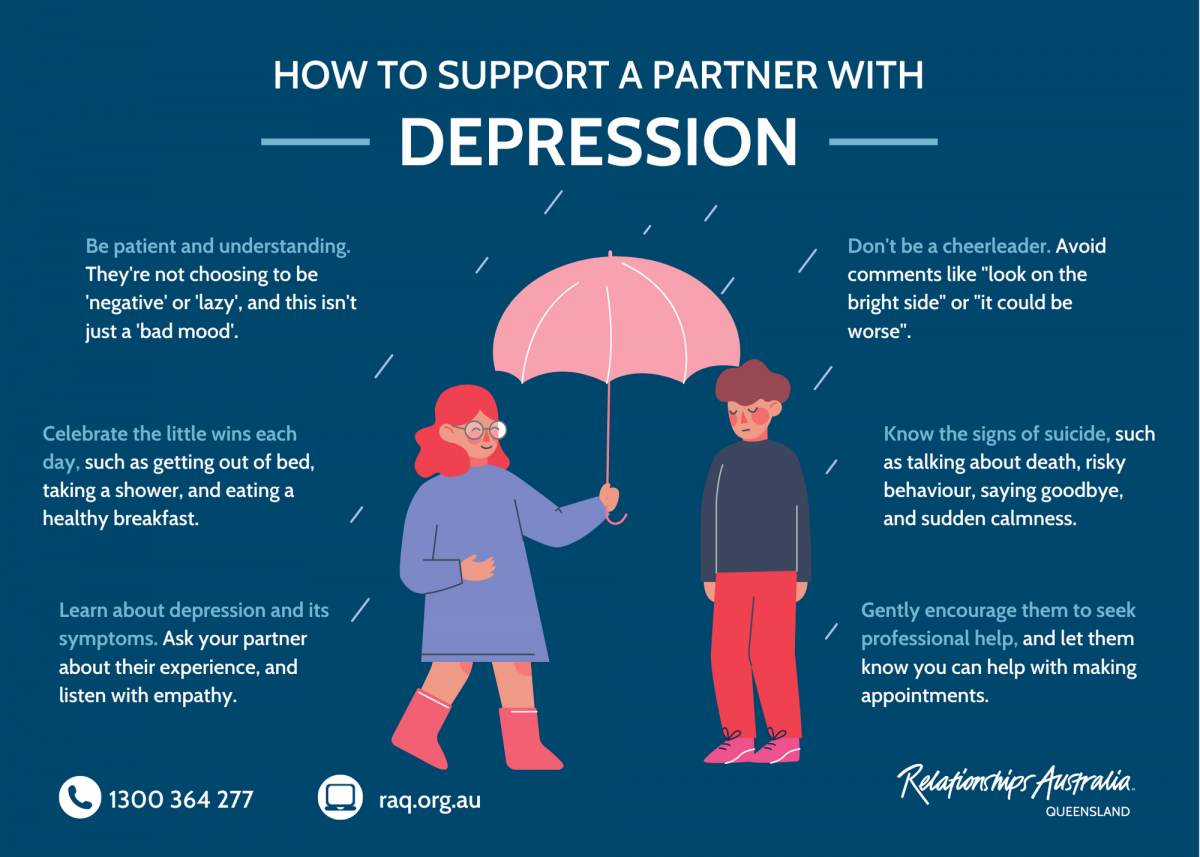
How to support a partner with depression tips in infographic

How to Handle Social Distancing When You Live Alone

For those who live alone, social distancing guidelines mean being more cut off than ever.

Self-isolation is impacting us all, but people stuck at home without company may be particularly struggling without human contact.

This is new territory for all of us. We’ve never had to physically isolate ourselves from our loved ones for an extended period of time before. And it’s totally normal to feel uncomfortable, anxious, and lonely.

If you live alone, there are a few ways to prioritise your mental health and make social distancing less lonely and more manageable.


Maintain Connections

Social distancing has our social calendars looking pretty sad. Enter: technology.

It’s more important than ever to maintain connections with friends and family – especially if you’re not getting your usual social fix in the home.

Replace in-person catch-ups with virtual check-ins via phone and video calls. Plenty of your normal social activities can be continued over video call – from book clubs to happy hour.

Try to schedule regular check-ins with your loved ones to maintain social contact and connect with your support network every week. They don’t have to be lengthy conversations every time – just a quick 10-minute chat can make all the difference.


Plan Something Exciting

Sure, we’ve had to cancel exciting social events and put plans on the backburner. But just because we may not be able to tick off our plans doesn’t mean we shouldn’t keep daydreaming about them.

According to research, anticipating a positive event can help reduce negative emotions, increase positive emotions, and improve our ability to cope during stressful times. So whether it’s a holiday or a party, planning an event to anticipate may help lift your spirits.


Find a Routine You Love

There’s a lot going on right now that’s out of our control. A great way to cope with uncertainty is to take control of what we can – like our daily routine. This is a great time to create new habits and make a routine you want to jump out of bed for.

When creating your routine, consider the activities that make you feel good and support you to accomplish the things you need to each day. For example, you might like to start the day with a walk and a shower to feel energised.

A few building blocks of a routine that supports mental health include:

  • Getting enough sleep
  • Eating healthy foods
  • Staying hydrated
  • Moving your body.
Want to see how famous historical figures like Benjamin Franklin and Pablo Picasso spent their days? Check out this interesting infographic.


Challenge Yourself

Keep your mind occupied by engaging in a creative pursuit. This could be learning a foreign language, picking up an instrument, trying a new recipe, or expressing yourself through painting.

Trying something new is a great way to stay busy, build confidence, and take your mind off worries and responsibilities for a while. In fact, research shows creative hobbies can reduce stress just as well as exercise.


Get Out of the House

Being cooped up at home without company is a recipe for cabin fever. Not to mention, entering hibernation mode can have negative impacts on your mental health.

Nature is known to help alleviate feelings of anxiety and boost your mood. So whether you’re going for a walk at a national park or simply appreciating your garden, take time to get outside in the fresh air and sunshine every day. If nothing else, it’ll at least give you a change of scenery from your living room.


Prioritise Self-Care

In the spirit of looking on the bright side, why not take self-isolation as an opportunity to focus on your self-care? COVID-19 has forced many of us to slow down and take stock of how we normally spend our time. And it turns out a lot of us don’t normally prioritise our self-care.

The current health situation is pretty overwhelming and stressful. So now that we have some spare time up our sleeves, we think it’s important to take extra care of our mental and emotional wellbeing.

Here are some self-care activities you can do during the coronavirus:

  • Take a bubble bath, complete with candles and music
  • Start the day with a guided meditation or some gentle stretching
  • Give yourself a pedicure while wearing a face mask
  • Put your phone on ‘do not disturb’ while reading a good book
  • Order your favourite meal from your favourite restaurant
  • Get a takeaway coffee or hot chocolate and drink it in a park (if social distancing rules allow you to).
Discover more tips to protect your emotional wellbeing during the coronavirus outbreak.


Talk to Someone

Finally, if you’re feeling lonely or not coping well during this tough time, reach out to someone you trust. Feelings of anxiety around the coronavirus and social distancing are normal, and talking them through can help you understand and manage these feelings.

If you don’t have someone to talk to, try writing your feelings down in a journal. Or you can call our telephone counsellors on 1300 364 277 between 8am-8pm Monday-Friday and 10am-4pm Saturday.

For more inspiration, check out these 10 ways to make the most of self-isolation.

Signs of a Controlling Relationship

What do you picture when you think of a controlling relationship?

Perhaps you imagine a partner who is physically aggressive. Or maybe one who dictates what their partner can and can’t wear.

While these behaviours are dangerous, there are many other signs of a controlling relationship that can be harder to spot. In fact, some people might not even realise when they’re in a controlling relationship. But whether these patterns lead to more severe emotional or physical abuse or not, this doesn’t make them any less unhealthy, hurtful, and damaging.

We asked Relationship and Family Counsellor Val Holden to share some of the red flags to watch out for, and advice if you’re experiencing or using control and manipulation in a relationship.


What is a Controlling Relationship?

A controlling relationship is one where one partner dominates the other in an unhealthy, self-serving manner. If your partner constantly makes you feel intimidated, insecure, or guilty, you could be in a controlling relationship. And control in a relationship is a form of abuse.

Val explains that abuse can come in many forms; it can be physical, emotional, sexual, financial, spiritual, and psychological.

“Does your partner make you feel guilty for having a good time or spending money?” she asks.

“Are you fearful to bring up something in a conversation because of the reaction you may get from your partner? Do you feel ashamed or made to feel stupid in front of friends or family? Do you ever question your sanity? If you have any of these feelings, you may be in an abusive relationship.”

Some signs of a controlling relationship might include:

Getting upset when you make plans without them

Your partner may not like it when you make plans that don’t include them, or when you leave the house without them. They might not want you to have a life outside of your relationship, and not respect your need for alone time. They might want to know where you are and who you’re with at all times, and constantly check in on you with texts and phone calls.

Making you feel guilty for spending time with family and friends

Similarly, your partner might make you feel bad about spending time with the people you love.

“Sometimes, these forms of control can come across as quite caring, or you may feel that your partner just really wants to spend time with only you,” Val explains. “’Stay home with me.’ ‘Why don’t we just

do something together?’ ‘We don’t need others in our relationship to be happy.’ Sounds nice, doesn’t it? But what if that happens all the time, and when you want to spend some time with your friends and family or have some space for yourself, you are made to feel guilty or selfish?”

Val advises that respect for each other’s needs and emotions, and respect for each other’s personal space and the ability to be yourselves, is paramount for a good relationship.

Overactive jealousy and accusations

A controlling partner may be overly jealous and regularly accuse you of flirting or cheating with other people without reason or evidence. While this might be a sign that they have their own insecurities or experiences from past infidelities to deal with, it’s unfair and unhealthy for them to constantly accuse you.

Going through your phone and belongings

Whether single or in a committed relationship, everyone deserves privacy. A partner who reads your texts, call history, emails, or looks through your belongings without consent doesn’t trust you or respect your boundaries.

Constant criticism

A controlling partner might undermine your confidence and make you feel insecure, putting you down in private and/or public. For example, they might criticise the way you dress or how you spend your time, exaggerate your ‘flaws’, or make fun of you in front of others but pass it off as ‘just a joke’.

Blaming you for everything

The ‘blame game’ is a popular one with controlling people. They might immediately take on the role of the victim and blame you for everything that goes wrong – even things that have nothing to do with you.

Making you doubt your reality

Some controlling partners don’t stop at trying to isolate you from your friends and family – they’ll also try to make you question your sense of reality. This common manipulation technique and form of emotional abuse is called “gaslighting”. It happens when a partner twists the truth to make you question your memories, instincts, and feelings.

An example of gaslighting might be when a partner sends you an upsetting text message, but when you approach them about it, they insist you misinterpreted it or you’re being too sensitive. Another example might be when a partner breaks a promise to cook you a nice dinner, and then blames you for making them feel bad about it.

Val offers some advice to anyone using control in their relationship.

“Trying to control your partner’s life, their emotions, and their ability to be themselves says more about you than them,” she says.

“If you are frightened and fearful and need to be able to control them, you will eventually push them away. You can never control someone – the relationship will eventually break down to become abusive an unhealthy.”


How to Cope in a Controlling Relationship

If you recognise these signs in your relationship, you should take them seriously. They’re unhealthy and destructive, and can lead to even more dangerous behaviours.

“First, recognise that you are in an abusive relationship, seek help from a professional counsellor, and make sure you are safe and can leave if you need to,” Val advises.

The good news is, some controlling relationships can be repaired if the unhealthy behaviour is addressed in a safe environment.

“Couples can work things out. Finding out what is really happening in the relationship and beginning to work on becoming more reflective on what is happening for you, or to you, is the start,” explains Val.

“Change can only happen when you seek to understand and respect yourself. Then begin to work on improving how you interact and react to each other. You need to start by owning your part in any argument, learning to let go, walk away, reflect and look at how to repair. This can all be done with a professional counsellor helping you to navigate your way through all these emotions and reactions.”

If you’re having a hard time in your relationship and need someone to talk to, you can access our free over-the-phone counselling on 1300 364 277 Monday-Friday between 8am-8pm and Saturday between 10am-4pm.

If you believe you or your children are in immediate danger, please call 000.

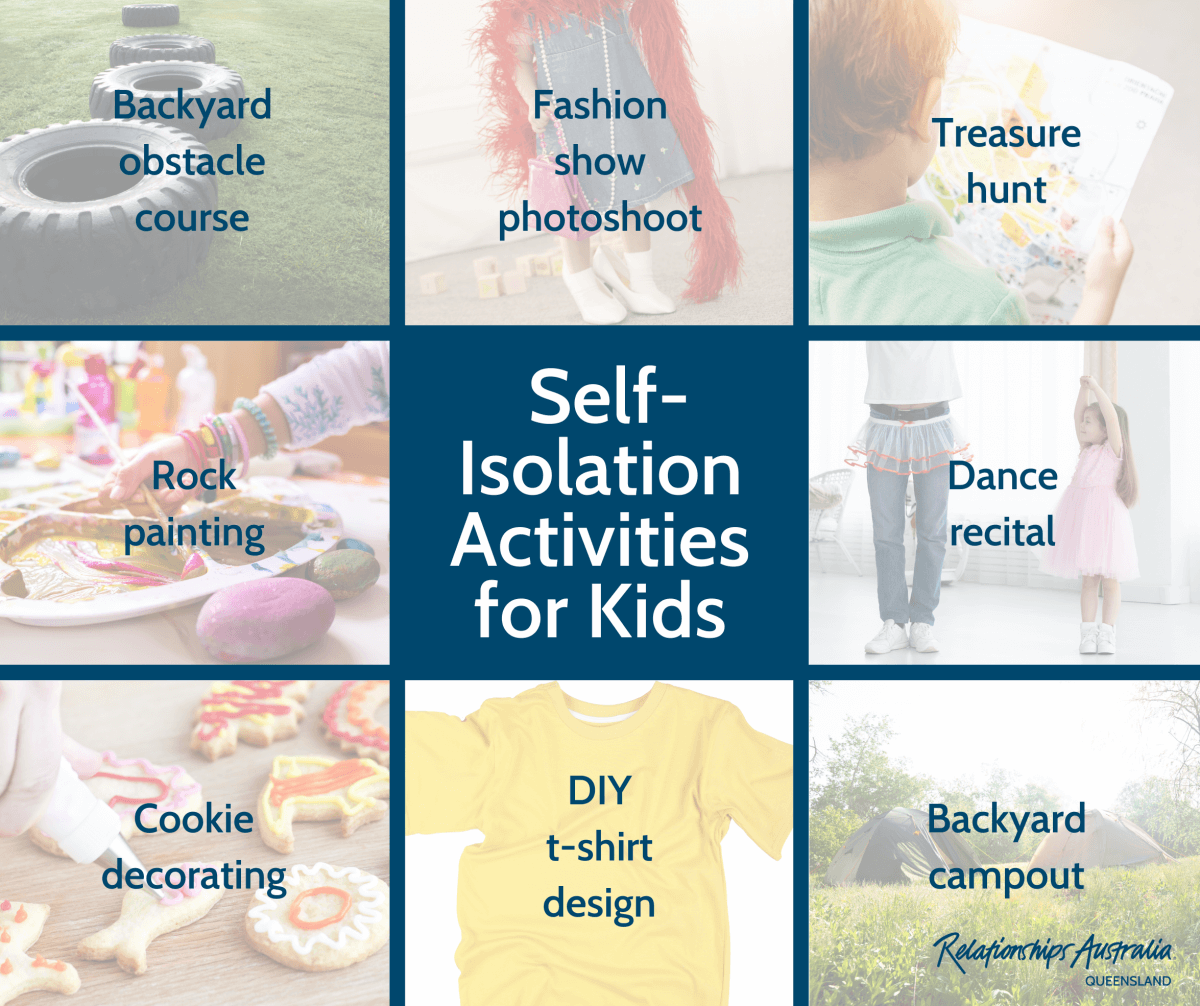
10 Fun Self-Isolation Activities for Kids

Trying to keep the kids entertained in self-isolation?

With schools, parks, and cinemas closed, many families are being forced to get creative with activities for kids stuck at home (there are only so many times you can watch Frozen II).

Keep the kids busy and your sanity intact with these quarantine activities for kids that can be enjoyed in the safety of your home and yard.


1. Exercise Dice

This is a great way to get kids moving and hold their attention for long enough to finish your coffee in peace. Just grab a die and assign an exercise or activity to each number, then get your children to take turns rolling it and performing the assigned action. Some exercise and activity ideas might include:

  • Jumping jacks
  • High knees
  • Hop on one leg
  • Air guitar
  • Pretend swimming
  • Penguin waddle.


2. Life-Size Drawings

Forget the A4 self-portrait and go big with life-size drawings! Get your child to lie down on butcher’s paper or several pieces of A4 paper stuck together and trace an outline of their body. Then they’re free to bring it to life by drawing their face and whatever outfit they wish.


3. Backyard Obstacle Course

Another great self-isolation activity for kids with energy to burn, a backyard obstacle course is sure to keep the whole family entertained. Add some friendly competition by making it a race against siblings or parents, or challenge your child to beat their best time. Some obstacle ideas might include:

  • Running through the rungs of a ladder flat on the ground
  • Jumping over laundry baskets
  • Weaving around buckets
  • Crawling under a broom balanced on chairs
  • Kicking a ball through DIY goalposts
  • Knocking over a tower of plastic cups
  • Balancing on a timber beam.


4. DIY T-Shirt Design

If you have a t-shirt, you have a canvas. T-shirt decorating is perfect for a couple of hours of creativity and imagination. Set your kids up with a plain t-shirt and some colourful fabric paints, pens, stencils and brushes, and watch as they express themselves.


5. Housebound Treasure Hunt

Make a basic map of your home and hide ‘treasures’ around it (e.g. chocolates or small toys), marking each piece of treasure on your map. For older kids who can read, make your treasure hunt a little harder and use written clues/riddles to help them. For example:

Clue: I have four legs but no feet. When you’re tired, take a seat.

Answer: Chair

This combination of quiz and hunt is a great way to keep young minds active and entertained.


6. Fashion Show Photoshoot

Kids will love rummaging through their closets and costume boxes to put together their favourite outfits to show off to the family. Put on some fun music and get your camera ready to capture their best poses on the catwalk.


7. Backyard Campout

While we may not be able to go camping at our favourite beach or bush campsites, the backyard is the next best thing. This is one of our favourite self-isolation activities for kids experiencing cabin fever and in need of a change of scenery. Pitch the tent and roll out the sleeping bags for a night under the stars in your own backyard. Don’t forget the marshmallows!


8. Rock Painting

All you need is some acrylic paint, small paint brushes, and some rocks, and you’ve got yourself an afternoon of creative fun. Give them a wipe over to remove any dirt, then let the kids let loose with their masterpieces.


9. Dance Recital

Mini movers and shakers will be in their element performing a dance routine for the family. Challenge your kids to come up with their own moves or learn choreography online, like this fun and easy dance to “Can’t Stop the Feeling” by Justine Timberlake.


10. Cookie Decorating

You can’t beat cookie decorating for a quiet (and delicious!) indoor activity. Grab some plain biscuits or cookies (like Arnott’s Milk Arrowroot) or bake your own sugar cookies for the kids to decorate. You can make circular cookies or mix things up with cookie cutters in fun shapes. Just wait for them to dry and equip your kids with icing, icing pens, sprinkles, and premade edible icing decorations.

For more fun ideas, check out our list of ways for grandparents to stay connected with their grandkids from afar.


If you’re having a tough time and need someone to talk to, call us on 1300 364 277. Our telephone counsellors are available Monday-Friday 8am-8pm and Saturday 10am-4pm.


Your Ultimate Coronavirus Source Guide

With so many pages, people and posts out there providing information around COVID-19, it can be hard to distinguish fact from fake. Some sources simply aren’t up to date with the latest info, and others intentionally set out to misinform their readers.

Understanding the coronavirus outbreak may help remove some of the anxiety surrounding it. But being bombarded with conflicting information can negatively impact your mental – and physical – wellbeing.

We’ve compiled a few reliable sources so you can stay informed and stay safe.


Official Pages for Health and Legislative Updates

World Health Organisation Official Updates

The World Health Organisation provides rolling updates on the evolution of the COVID-19 pandemic on a global level.

Australian Federal Government Official Updates

The Australian Government website is regularly updated to give you the latest Coronavirus news, updates and advice from government agencies across Australia. They also have their own app where you can access information.

You can download the app here:

Queensland Health Official Updates

Queensland Health provides local statistics on a state level, important information relevant for Queenslanders (including self-quarantine requirements and links to current legislation), and a self-assessment tool to help you check your symptoms if you are feeling unwell.

Australian Travel Advice

Smartraveller is regularly updated with the latest information and advice for Australians to stay safe overseas, including current travel bans and what to do when you can’t get home.


Resources for Working from Home

Safe Work Australia offers information and advice for working from home, including WHS requirements and risks.

Comcare has provided a Working from Home Checklist to help you create a safe work environment at home and avoid risks to your physical and mental health.

The Learning Blog by LinkedIn has helpfully provided a compilation of tools and resources for working from home effectively. This includes short online courses that cover topics such as productivity, time management, health and wellbeing, how to use tools like Skype and Zoom, and more.


Resources for Co-Parents

The Family Court of Australia provides an extensive list of questions and answers with official information and advice regarding co-parenting arrangements and court orders during COVID-19.


Resources for Maintaining Your Mental Wellbeing

And, of course, here at Relationships Australia Queensland, we always strive to provide relevant and valuable information to you within our areas of expertise. From coping with the grief of coronavirus cancellations, to self-isolation date night ideas, you can check out our latest advice on our blog.

Have you come across other resources with credible and useful information? Head over to our Facebook page and let us know.

10 Tips for Working from Home During the Coronavirus

While those of us who are able to do our jobs from home right now are extremely lucky, this doesn’t mean that working from home doesn’t have its challenges.

Working from home can be great – until your toddler wants to play on your keyboard, or that new release on Netflix becomes too tempting.

Yep, it can be tough to stay focused at home. Sure, we don’t have our co-workers dropping by our desk or inviting us to lunch. But the home office can pose even more distractions and make it seem almost impossible to separate our work from our personal life.

If you’re struggling to stay productive or maintain a healthy work-life balance while working from home, this one’s for you.


1. Create a Designated Workspace

The most important thing when it comes to working from home (apart from snacks) is to create a workspace that allows you to comfortably and efficiently do your job.

Find a room or space in your home that you can dedicate entirely to work – preferably one with a comfortable chair and desk setup, sufficient lighting, and no distractions (i.e. the TV, fridge, or roommates constantly coming and going).

It might be tempting to slouch down on the couch with your laptop, but this will likely hinder your productivity and make it harder to switch off when you want to relax on that couch after knocking off for the day.

Check out Comcare’s working from home checklist to ensure you’re staying safe and healthy while working from home during COVID-19.


2. Get Dressed

Working from home gives us the freedom to wear whatever we want – but that doesn’t necessarily mean we should.

Ditching the pyjamas and putting on ‘real clothes’ helps flick the switch in our brain to get into work mode. We’re not saying you need to suit up or don your usual perfectly pressed work uniform, but sitting around in your PJs isn’t always the best for your motivation.

Get up, get showered, and get dressed in something comfortable and clean that makes you feel ready to take on the day (and semi-presentable for those Zoom meetings or the postie).


3. Maintain Regular Working Hours

We know, we know – sleeping in is life. But transitioning straight from your pillow to your computer screen can be jarring. While working from home allows flexibility with your working hours, it’s important to maintain a routine and manage your time effectively to avoid overlap in your work and personal time.

Structure the day like you would in the office or your normal work environment, commit to set working hours, and enforce a strict finishing time at the end of the day. Communicate your work schedule with your team so they know when to reach you – and when to leave you to walk the dog or finish that puzzle.


4. Take Scheduled Breaks

Maybe you feel obligated to be reachable and responsive at all times while working remotely. Or perhaps you’re just not sure how to spend your breaks when you’re stuck inside. Whatever your reason for powering through until knock-off time, you’re only doing yourself – and the quality of your work – a disservice.

Believe it or not, burnout is a real risk factor even when working from the comfort of your own home. Regular breaks are key to helping sustain your concentration and energy levels throughout the day. Research shows workers feel more engaged and productive when they make time to take a lunch break every day.

So set a few alarms and force yourself to get away from your screens, stretch your legs, and recharge.


5. Leave the House (if You Can)

Getting some fresh air and sunshine can do you a world of good when you’re stuck inside looking at a screen all day. Mounting research proves the benefits of spending time outdoors for our mental and physical health, so it’s worth booking in some time with the open sky each day if you can.

Depending on the current guidelines and directions for your state or territory, you might like to go for a walk or do a workout in a nearby park. Otherwise, you can head to your own backyard to eat lunch alfresco, read a book, or listen to music.


6. Listen to White Noise to Drown Out Distracting Sounds

If you have kids, pets, noisy neighbours, or live near a busy road, this background noise can make it hard to concentrate.

Invest in some noise-cancelling headphones and listen to your favourite tunes or white noise to drown out distracting sounds. Soothing, neutral sounds like rain or crashing ocean waves are great for masking background noise.

Rainy Mood and Noises Online are popular sites offering free, uninterrupted white noise for as long as you need.


7. Keep in Touch with Colleagues

Social distancing can create a disconnection with our colleagues, and even introverts might find themselves missing the social aspect of their normal work environment. Our need for these connections goes beyond a bit of banter and bonding over the coffee machine; our workmates help us stay happy and productive on the job.

A recent study revealed that relationships with co-workers is “the top driver of employee engagement, with 77% of participants listing these connections as a priority”.

Regularly checking in with your workmates may help boost your morale and motivation. Not only will it keep everyone on the same page in terms of work tasks, but it’ll also be nice to talk to people in the same boat as you during these uncertain times. Try setting up a weekly video call or signing up to Workplace by Facebook to stay in touch outside of work-related emails.


8. Activate ‘Do Not Disturb’ Outside of Work Hours

Does anyone else feel like we’re stuck in that awkward time between Christmas and New Year’s where you don’t know what day it is (without the festive spirit, of course)?

The lines between work time and personal time are blurring. Afternoons are blending with evenings. Weekdays are blending with weekends.

Working from home is making it harder to maintain a healthy work-life balance, and setting boundaries with our colleagues, boss, and clients is key to keeping work separated from our downtime. Putting work email notifications on ‘do not disturb’ and turning your work phone off outside of your working hours is a great place to start.


9. Take Sick Days When You Need Them

In a time where technology allows many of us to perform at least some of the aspects of our jobs from home, it can be tempting to soldier on when we’re sick.

But if you’re feeling too unwell to do your job, even from home, you’re entitled to take sick leave – and you should. If your contract allows you paid sick leave, your employer can’t expect you to continue to work from home. So if you’re sick, take your sick leave and leave your inbox for tomorrow.


10. Look after Yourself

It’s normal to feel a bit out of sorts with all the changes happening around us. Be sure to prioritise your mental health and make time to do things you enjoy, like taking a walk or talking to friends and family.

If you’re struggling, you can talk to one of our telephone counsellors on 1300 364 277 between 8am and 8pm Monday-Friday or 10am-4pm Saturday.

Check out our article How to Protect Your Emotional Wellbeing in the Coronavirus Outbreak for some more practical tips from one of our clinical supervisors.


Tips for working from home infographic

How to Work from Home with Your Partner

Sharing might be caring, but sharing a space with another person 24/7 can put a strain on even the strongest of partnerships.

Let’s acknowledge right now that anyone who still has a job, and can perform that job from the relative safety of their home, is really lucky.

In saying that, though, it’s normal to find it challenging – especially if you’ve never worked from home before. Add a partner, housemate, parent or friend to that situation and it can be a recipe for tough times.

It’s OK to find working from home with your partner hard.

No matter how much we like or love someone, being in close quarters all the time can wear thin very quickly.

So how can we make it a little easier for everyone?


Tip 1: Separate your workspaces (if you can)

If you’re able to, create workspaces in separate rooms. This will allow you to have your own little area to set up your things, get comfortable, take calls and focus on your job without having someone else breathing down your neck.

If your home doesn’t cater to separate rooms for work, try setting up a physical or psychological barrier to divide your areas. By creating that sense of separation, you may find it easier to tune out little things like food packets rustling while you’re in an important meeting, or dirty dishes in your partner’s ‘zone’.


Tip 2: Share schedules with each other

Touch base each week or day to run through important meetings coming up, big tasks to get done or times where you’ll need to really knuckle down.

That way you can each be aware of periods where the other may be experiencing higher levels of stress than normal and know whether it’s OK to interrupt to ask if the milk is still good to drink.


Tip 3: Adopt a non-verbal communication system

Partners ‘Zoom-bombing’ meetings can be a hilarious interlude or a distracting disruption, depending on the tone of the meeting and the culture of your workplace. To avoid having to awkwardly explain why your at-home ‘workmate’ can be seen and heard dancing and singing in the background of your webcam, have some sort of signal to let your partner know you’re on a call or video meeting.

For example, you could adopt a red light, green light system with each other, with red light meaning please stay away while green light means feel free to pop in and say hi. It works for more than just meetings, too. You can also use it to let the other person know when you need a clear headspace to focus on the work at hand.


Tip 4: Spend time apart from each other

When you’re in each other’s pockets during work time, relaxation time and sleep time, it’s important to make a conscious effort to dedicate a slice of each day to spend on your own.

It doesn’t matter how you use that part of the day – you could try walking, painting, reading in the garden, playing a video game or just chatting to the birds outside. It’s more important that you spend it alone to give yourself time to feel your emotions, think about your day, and reset your mind.

It can even give you something to talk about later when conversation topics are running dry. When you spend every second together, there’s nothing new that the other doesn’t already know about. But when you have some time away, you can chat about the kind person you passed while out for a walk, the aggressive duck you saw at the lake, or the bee that almost stung you in the garden.


Tip 5: Keep the romance (or friendship) alive

It’s very easy to be sucked into the mundane of your daily routine when options for outings are so limited. Dedicating an evening to keeping the spark of romance or friendship alive is a great way to connect on a deeper level.

Whether you’re working from home with your partner, or with a housemate or family member, you can invite them to a ‘date night’ or a ‘mates’ night’.

Plan your time to include things you don’t do every other night. For example, if you usually cook separately, cook a meal together instead, or support a local restaurant by grabbing some takeaway. And instead of streaming your standard TV series, dust off the board games and see who the trivia master really is. For more inspiration on things you can do while self-isolating, check out these 10 ideas for date nights.

Keep in mind that everyone handles stressful times differently and one common reaction is to become short-tempered and unhappy. If this sounds like you or your partner, and if things just become too much to handle, it’s important to seek help. It’s normal to struggle, but struggling alone isn’t your only option.

To talk to a telephone counsellor, you can call us on 1300 364 277.


Have you got another tip you can share with us? Let us know on our Facebook page!

How to Protect Yourself Online During the Coronavirus

Many of us are turning to technology to connect with our loved ones during the coronavirus outbreak.

Tools like video chat, instant messaging, and online gaming make it easier than ever to keep in touch with each other. But for some people, using technology can also pose a risk to their own safety.

If you’re experiencing or living with family and domestic violence, being careful online is a key part of looking after your physical and emotional wellbeing.

So how can you make sure you’re protecting your online safety during a time when you’re actively encouraged to connect with others?

We hope these tips can help.


Use a Safe Device

One of the best ways to protect your privacy is to only use the internet on a ‘safe device’. A safe device is a personal phone or computer that other people can’t access.

If you’re in a situation where you have to share your device with others right now, that’s okay. The following tips can still help you keep your personal browsing history and online activity private.


Update Your Passwords

Having a secure password that only you know is a good way to protect your online safety.

The most secure passwords are random strings of numbers and letters, so consider using an online generator like this one to create new passwords for all of your accounts.

Alternatively, you can use something called a ‘passphrase’, which is a string of random words.

Something like ‘horse battery staples manager’ is a lot harder to guess than your birthday.

Here is a website to generate passphrases.

No matter what method you use, try and create a unique password for every account you have.


Protect Your Passwords with a Password Manager

It can be tricky to remember all your passwords – especially if you’ve used a generator to create new, more secure ones.

You might be tempted to click ‘save password’ when it pops up in your browser so you don’t have to worry about remembering it, but this isn’t very safe.

Password managers act like a safer version of the ‘save password’ feature by keeping all of your passwords locked behind a ‘master password’.

When you’re online, all you have to do is type your ‘master password’ into the password manager, and it will automatically fill out all of your secure passwords for you.

This means you only have to remember your master password instead of a whole list!

Here is a list of some free password managers to get you started.


Change Your Account Settings

Another easy way to improve your online safety is to double-check the privacy settings of all your accounts.

For social media websites like Facebook and Instagram, the default privacy settings might mean people you don’t know can see everything from your posts to your phone number.

By adjusting these settings, you limit the number of people who have access to your social media profile and information.

This can reduce the risk of you showing up on strangers’ feeds.

It’s a good idea to adjust these settings on your children’s social media accounts to keep them safe, too.


Use ‘Private Browsing’ Mode and Delete Your Browser History

Regular search engines such as Google will keep track of websites you’ve visited and things you’ve downloaded in your browser history. This is information you might not want shared with others.

While you can manually delete your browser history, you can also use the ‘private browsing’ feature on these websites.

When privately browsing, the search engine will not track your browser history and there will be no record of the websites you’ve visited.


Turn off Your Location Services

Many phones have location services, such as GPS, automatically turned on. This can make it easy for other people to track your location, but these settings can be turned off.

Some photo-sharing apps, such as Instagram or Facebook, have ‘geotags’ in their photos that tell people where the photo was taken.

To avoid these photos telling people where you are, consider asking friends not to tag you, or adjust the settings on your account to stop others from tagging you.

Finally, when going to places that you don’t want anyone to know about, such as a counselling appointment, turn off your phone where possible.


Create a New Account

If you’re concerned your current accounts are still being monitored or shared, you can create a new social media account to keep in touch with your loved ones privately.

When making the new social media account, use a fake name or your middle name to make it harder to trace back to you.

Link the new account to an email with an anonymous name, such as greendog@hotmail.com, for extra security.

Always make sure to log out of your accounts after you’re done using them.


Stay Safe

Remember that even under coronavirus restrictions, you can still leave your environment to escape harm without incurring a fine.

Coronavirus is not an excuse for abuse, and it is never okay in any circumstances.

Lots of services are still running at this time to make sure help is available if you need it.

You can give our telephone counsellors a call on 1300 364 277 anytime between 8AM-8PM Monday-Friday and 10AM-4PM Saturday.

The 1800RESPECT hotline also provides family and domestic violence counselling 24/7: 1800 737 732.

If you feel like your wellbeing, or that of your children, is in immediate danger, please call 000.