1300 364 277
Quick Exit
This button appears across the site. Press this button to exit the site immediately to nondescript link
Click to close or press

Marriage Equality Bill passes parliament

At 5.58pm on 7 December 2017 history was made by the Parliament of Australia passing the Marriage Equality Bill. The bill received overwhelming support from almost all parties – the Nationals, Liberals, Greens, the crossbench and Labor, and their vote was cheered on by a packed public gallery.

The change is a simple one. From Saturday, 9 December, marriage will be the ‘union of two people to the exclusion of all others, voluntarily entered into for life’. It means that same-sex couples will have the same rights as all other couples.

Relationships Australia strongly believes that marriage equality is critical, and joined the call for Australians to vote ‘yes’ in the recent postal survey. We are pleased to see that yesterday, most elected representatives voted according to their electorate’s wishes.

Marriage equality, quick facts:

  • Australia is the 26th country in the world to legalise same-sex marriage
  • From Saturday, 9 December anybody wishing to marry will be able to lodge a Notice of Intended Marriage
  • The notice of intended marriage starts the one month minimum notice period required before the solemnisation of marriages under the Marriage Act.
  • The first day couples can marry is 9 January 2018

Relationships Australia joins leading health organisations supporting marriage equality

Marriage Discrimination is Harmful to LGBTI Australians’ Health

As leading health organisations we call on the Australian Government to legislate for marriage equality and put an end to marriage discrimination.

It is our shared professional opinion, based on conclusive evidence, that denying people the right to marry is harmful to their health and wellbeing.1

The longer we delay marriage equality, the longer people in LGBTI communities will experience the negative health impacts of being denied access to the same rights, privileges, responsibilities and institutions as the rest of the population.2 This is a burden on these communities as well as our health system.

The evidence clearly shows that LGBTI communities have significantly higher rates of depression, anxiety, substance abuse, self-harm, suicidal ideation and suicide than the general population.3

LGBTI people have poorer health outcomes not because of who they are, but because of societal stigma, discrimination and prejudice that results in their ill treatment and social isolation.

In addition, given past negative experiences, some LGBTI people are also reluctant to access healthcare services, resulting in delayed treatment, which further contributes to poor health outcomes.

Australians have always valued the principle of a fair go for everyone, but LGBTI Australians are not getting a fair go when it comes to marriage, and this inequality is negatively impacting their health.

Discriminatory legislation is an impediment to LGBTI people achieving the highest attainable standard of health. In line with our human rights obligations, Australia must legislate for marriage equality.

Our elected representatives have the opportunity to create lasting and positive change that the community supports. It is time to legislate for marriage equality, and help close the health gap created by marriage discrimination against LGBTI Australians.


  1. http://www.acon.org.au/wp-content/uploads/2016/09/Marriage-Equality-Evidence-Review_web.pdf; https://ama.com.au/system/tdf/documents/Marriage%20Equality%20-%202017%20-%20AMA%20position%20statement.pdf?file=1&type=node&id=46077; https://www.ranzcp.org/Files/Resources/College_Statements/Position_Statements/PS-83-LGBTI-mental-health-2016.aspx; https://mhaustralia.org/general/marriage-equality-statement
  2. http://jamanetwork.com/journals/jamapediatrics/fullarticle/2604258
  3. http://lgbtihealth.org.au/wp-content/uploads/2016/07/SNAPSHOT-Mental-Health-and-Suicide-Prevention-Outcomes-for-LGBTIpeople-and-communities.pdf; https://aspe.hhs.gov/system/files/pdf/75106/report.pdf

World Elder Abuse Awareness Day – June 15

Relationships Australia Qld is supporting the United Nations World Elder Abuse Awareness Day (WEAAD) on Thursday June 15. On this day communities across the world honour our older people, and uphold their right to live in safety, with dignity and respect. WEAAD is an opportunity to make the community aware that many older people experience mistreatment from people close to them, often their family members.

Relationships Australia Qld CEO Dr Ian Law said that WEAAD was an important day to recognise the challenges faced by our Elders and their families, and to assure the community that support is available.

“Relationships Australia Qld offers counselling and mediation services which can support families to navigate the complex issues and decisions related to aging, and reduce the incidence of elder abuse.

“Just as respectful relationships within families protect against issues such as family violence, respect for older family members is fundamental in protecting against elder abuse.” Dr Law said.

Elder abuse is any act which causes harm to an older person and is carried out by someone they know and trust, such as a family member or friend. The abuse may be physical, social, financial, psychological or sexual and can include mistreatment and neglect.

In most cases elder abuse is an intergenerational form of family violence. In 2016, people aged 60 years or over made up just over 5,400 of the family members affected in family violence incidents recorded by Victoria Police (Crime Statistics Agency https://www.crimestatistics.vic.gov.au/).

Warning signs of elder abuse may include an older person seeming fearful, anxious or isolated. There may be injuries, or an absence of personal care. Disappearance of possessions, unexplained financial transactions, and changes to a will, property title or other documents are also of concern. While the mistreatment of an older person may be carried out by a family member, it is often other family members who are best placed to support their parent or grandparent against the abuse, provided they recognise what is happening. Like other forms of family violence, most elder abuse occurs behind closed doors, so it is important for loved ones to watch out for signs, listen and offer help.

To report elder abuse or to seek advice contact the agencies listed on My Aged Care.

To access Relationships Australia Queensland services, phone 1300 364 277.

Working with those impacted by Cyclone Debbie

Clarke Creek is a small community 2.5 hours south of Mackay and one of the remote and regional communities hardest hit after ex-tropical Cyclone Debbie crossed the Queensland Coast almost two weeks ago. The community of approximately 170 residents has been doing it tough coming to grips with the damage and huge financial costs they face as the clean-up in this community continues. Over the weekend, two counsellors from the Mackay venue travelled with a team of other workers from the Department of Communities and other government agencies to provide support and assistance to the Clarke Creek community. RAQ will continue to provide ongoing counselling support to this community working with the Department’s outreach teams from Mackay, Bowen and Proserpine. As the floodwaters recede in Rockhampton and residents begin the clean-up, RAQ continues to work with the local disaster management committee and provide community response services. Our staff are continuing to provide support to clients who access our services and to the broader community. RAQ sincerely thanks our staff for their commitment to their clients and communities and the contribution they have made during the past two weeks. All our venues are now open as usual including Bowen, Mackay and Rockhampton.

Launch of Queensland Violence against Women Prevention Plan 2016-22

On 3rd November 2016, the Queensland Office for Women and Domestic Violence Reform announced the release of the Queensland Violence against Women Prevention Plan 2016-22.  

The Plan has been designed to address the gendered nature of violence against women and represents the final piece of the Queensland policy framework to address violence against women and children in Queensland. It will complement the Domestic and Family Violence Prevention Strategy 2016–2026, Queensland says: not now, not ever, and supports the Government commitment to the National Plan to Reduce Violence against Women and their Children 2010–2022 and the implementation of the safety priority area of the Queensland Women’s Strategy 2016–21.

For more information and a copy of the Queensland Violence against Women Prevention Plan, visit https://www.communities.qld.gov.au/communityservices/women/queensland-violence-against-women-prevention-plan

Domestic and Family Violence Protection and Other Legislation Amendment Bill 2016

Domestic and Family Violence Protection and Other Legislation Amendment Bill 2016

The Domestic and Family Violence Protection and Other Legislation Amendment Bill 2016 (the Bill) was passed by the Queensland Parliament on 11 October 2016.

The Bill is part of an ongoing reform process in response to the report of the Special Taskforce on Domestic and Family Violence in Queensland and makes important improvements to better protect victims of domestic and family violence and their families, strengthen the justice response to domestic and family violence, and support the delivery of integrated service responses.  

Information on the key changes is provided in the factsheet.

The amendments will commence on a day to be fixed by proclamation.

RESPONSIBLE GAMBLING AWARENESS WEEK – 25 to 31 July 2016

Today sees the start of Responsible Gambling Awareness Week (RGAW) in Queensland, an event established to raise awareness of the importance of gambling responsibly.
 
With the many opportunities readily available to gamble in today’s society, it is becoming much more important to know how to gamble responsibly and know that support is available if needed.
 
The Relationship Australia Queensland (RAQ) Gambling Help Service (GHS) assists people to respond to problems associated with gambling. This service can assist if:
  • you are concerned about your own gambling;
  • you are affected by the gambling of a family member or friend;
  • you are a health and community support worker, worker with people affected by problem gambling; or
  • you are a community member interested in understanding more about responsible and problem gambling.
Problems associated with gambling can be wide ranging and include: financial issues, emotional issues, relationship issues, employment and employability issues, legal issues and physical and mental health issues.
Here are just some of the activities (green themed) that are happening around the state to support Responsible Gambling Awareness Week.
 

BRISBANE

Industry Launch:  The official RGAW Launch will be opened at the Kedron-Wavell Leagues Club by Queensland Attorney-General, the Hon Yvette D’Ath MP, followed by guest speaker Dr Nerilee Hing, PhD. Research Professor, Gambling Studies Central Queensland University.

Light up the City:  Victoria Bridge, which connects South Bank to Brisbane CBD, and the Story Bridge, will be lit up green throughout the week to support RGAW.

Community BBQ: RAQ Spring Hill is hosting a community BBQ on Thursday 28 July to raise awareness of responsible gambling.
 

GOLD COAST

Gold Coast Titans vs Parramatta Eels Game –  Mermaid Beach Gambling Help staff will be set up at the entrance of Round 20 Titans v Eels game on Saturday 23 July & Round 21 Titans v Sharks game on Monday 1 August. There will also be a short RGAW clip played on the big screen during the game.

IPSWICH

Riverlink Shopping Centre Display: Ipswich GHS will have a stall all week set up out the front of Kmart at Riverlink Shopping Centre giving out free treats for the children and promotional giveaways. 

Promotional and Information Packs: Promotional materials have been distributed throughout Ipswich, including the local library, Coles, medical centres and local universities.


GLADSTONE

Screening of No More Bets, Please!: Gambling Help staff in Gladstone will be hosting a screening of the film No More Bets, Please! at the Gladstone RAQ Venue on Friday 29 July from 1pm – 2pm.
 

MACKAY & WHITSUNDAYS

Library & Community Displays: Four Libraries in the Mackay Region have Gambling Awareness display tables set up for the week as well as Bowen Library in the Whitsundays region. The Sarina Neighbourhood Centre and Moranbah District Support Service will also be decorating their administration area with the promotional material and going green for the week.

Gaming Packs: 41 gaming venues have come together in the Mackay and Whitsunday Region and will be handing out information packs to any patron that wins over a certain cash amount during this week. We have collaborated with Uniting Care Communities and put together 300 packs in total. These packs include gambling help information, financial counselling information, pens, and water bottles from Mackay City Council and promotional material from a few local gaming venues (e.g. hats and drink coolers promoting their club or football team).


Other RAQ Venues

Green Staff Meetings and Morning Teas: A number of RAQ venues will be going green for RGAW week and will be holding green themed staff meetings and or morning teas.
 
To make an appointment to talk with a councellor or educator, please call the Gambling Helpline on 1800 858 858. This service is available 24 hours, 7 days a week and can assist you to find services in your local area.  
 
Or visit our Gambling Help Services Page for more information: http://www.raq.org.au/services/gambling-help-program-ghs
 
If you require crisis assistance, call Lifeline 13 11 14 or if you are in immediate danger contact 000. 
The Power of Words

Communication, conflict management, and family separation is my field.  Today on my drive to work I was pondering the power of words. How easy it is for words to influence our feelings and interpretation of situations and things. 

With separated families we will often use the words “the other parent” or “the child’s mother/father”, or perhaps “Jimmy’s dad”. This may not seem like a big deal, however many parents in a separated family situation often refer to the other parent as “their ex” or many other not-so-pleasant names.  You know the type of things I mean.

When someone is “your ex” it is all about the intimate personal relationship you shared but no longer have… and often this connection brings up feelings such as anger, resentment, guilt, grief, disappointment, and so on.  Why would you have anything to do with “your ex” after you’ve separated?  Usually it is only because there are children involved.  Therefore your relationship is no longer about that intimate personal relationship which hasn’t worked out for whatever reason—it is about you both being parents to your children.   

One mother I was working with referred to her son’s father by some pretty strong names, even more when she was talking to her current partner.  Although she did not do this in front of the child, I decided to discuss the power of words.  I explained basically similar to what I have above.  She’d always spoken with so much anger and hatred about her son’s father in our sessions. 

It was some time before speaking with her again.  She seemed different when she came in and when I asked how she was, she surprised me with what she proceeded to tell me.  She had taken on the wording I had spoken to her about and only referred to her son’s father as the child’s dad or by dad’s proper name or child’s father.  She said she felt a difference in how she felt, she didn’t feel as consistently angry towards him anymore.  She explained that the teachers had even mentioned a positive change in the child – “he seems more settled” they told her.  She had even noticed that when she went to the children’s contact center for changeover she asked if child’s father was here yet and noticed her son was happier and more relaxed.  It was then she had realised that previously she always had this anger when she thought about “him” and when going to changeovers she would ask in a harsh tone “is HE here yet.” 

It was such a positive story and outcome. 

Now over to you. How do you communicate with your children and others about your children’s parent?  Do your words reflect your feelings and/or do they tell your child that their other parent is someone you hate?  What consequences are there for you and your child to the words you use? 

Everyone would remember the little taunt at school, “Sticks and stones will break my bones but names will never hurt me.”  When my sons attended school the school changed this saying to respond to the recognized potentially damaging power words have. 

We have a little poster at work which says, “Every arrow you shoot at the other parent goes straight through your child’s heart.”  How many arrows have you shot? 

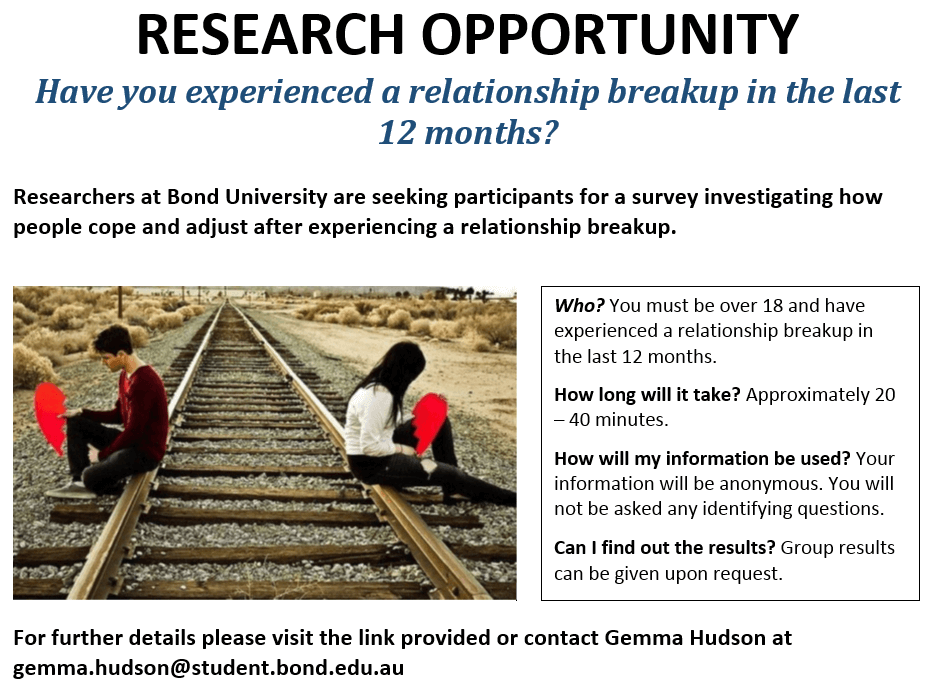
Research Opportunity: Have you experienced a relationship breakup in the last 12 months?

Have you experienced a relationship breakup in the last 12 months?

Researchers at Bond University are investigating how well individuals cope with relationship breakups. By understanding how individuals adjust after experiencing a relationship breakup the researchers hope to provide information on how to minimise distress following relationship breakdown.

This questionnaire will take approximately 40 minutes to complete and you must be over the age of 18 to participate.

This research has human ethics approval.

For more information and to participate please visit: https://www.psychdata.com/s.asp?SID=169188 


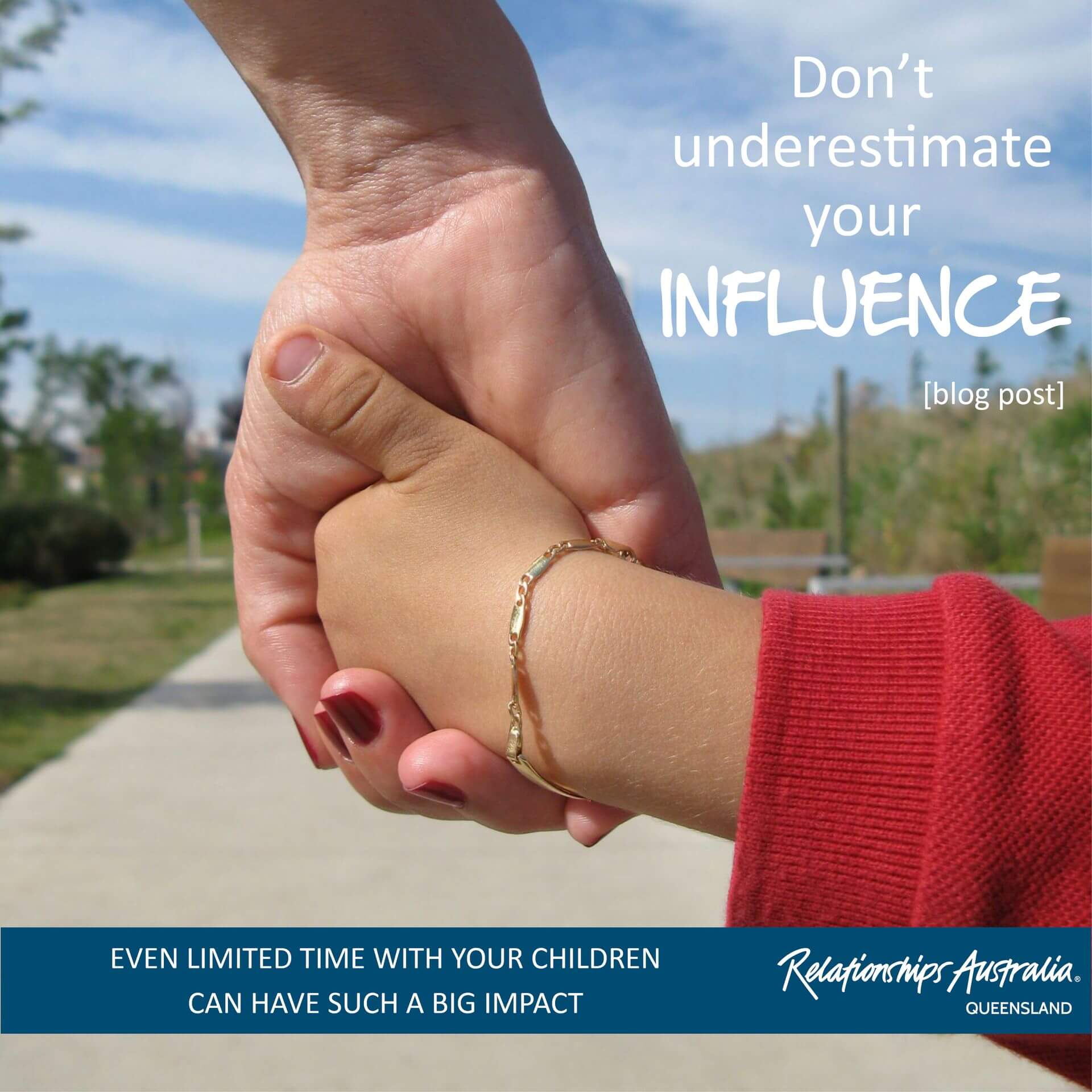
Don’t Underestimate Your Influence

Recently a co-worker came in to the office with a young boy who hasn’t had the easiest of times in his life and on this particular day a significant event had occurred.  As the worker involved had a number of things to organise and discuss with the manager, I spent some time entertaining this 5yo. It didn’t take much and we were soon engrossed with pretending to change the tyres on the toy trucks and so on, with quite a few giggles from our young guest. To be honest accessing my own inner child and engaging with a child on their level is always enjoyable for me!

It was obvious he had no desire to discuss anything heavy and under the circumstances that was perfectly fine, he didn’t need to. After a short while he peers at me and states that he remembers me. He believes I’m a woman who used to come to his school (in a totally different town) and help him. He remembered her name and the things she did. I said that this lady sounds like she was very helpful and nice to you, however, it just wasn’t me.

While we were spending time together he would get that inquiring look on his face and continued to say that I was that lady. When I tied his shoe lace for him he said “See? Don’t you remember doing this for me at my old school?”

The point to this story is that the person he is talking about is real. However it was some time ago that she had been involved in this young man’s life, yet he remembers her name and the things she did to help him, the kindness she showed.

In my job I see so many separated parents who are upset by the limited time they have with their children – and this is completely understandable. However, don’t underestimate the influence or effect the time you do spend with your child has on them. Remember a special fond memory from your own childhood. Most times it is something repetitive like, “We would always…” Other times it’s an occasional thing and that’s what made it special; “Sometimes we…” Then there memories like “Once we…”

Importantly, it’s usually what most would class as small things which people identify as the bases of warm, fond memories. Engaging and being present makes an incredible difference to a child. Don’t underestimate the influence this can have.


— Carolyn, Family Dispute Resolution Practitioner @ Relationships Australia Qld

** If you could like help with making arrangements and agreements following separation, please call us on 1300 364 277 to discuss your options.

BE SOCIAL, SHARE!

This post might help or reassure someone you know. Please share this blog by using the orange SHARE link at the top of the page. You can also subscribe to receive future blogs straight to your inbox.