1300 364 277
Quick Exit
This button appears across the site. Press this button to exit the site immediately to nondescript link
Click to close or press

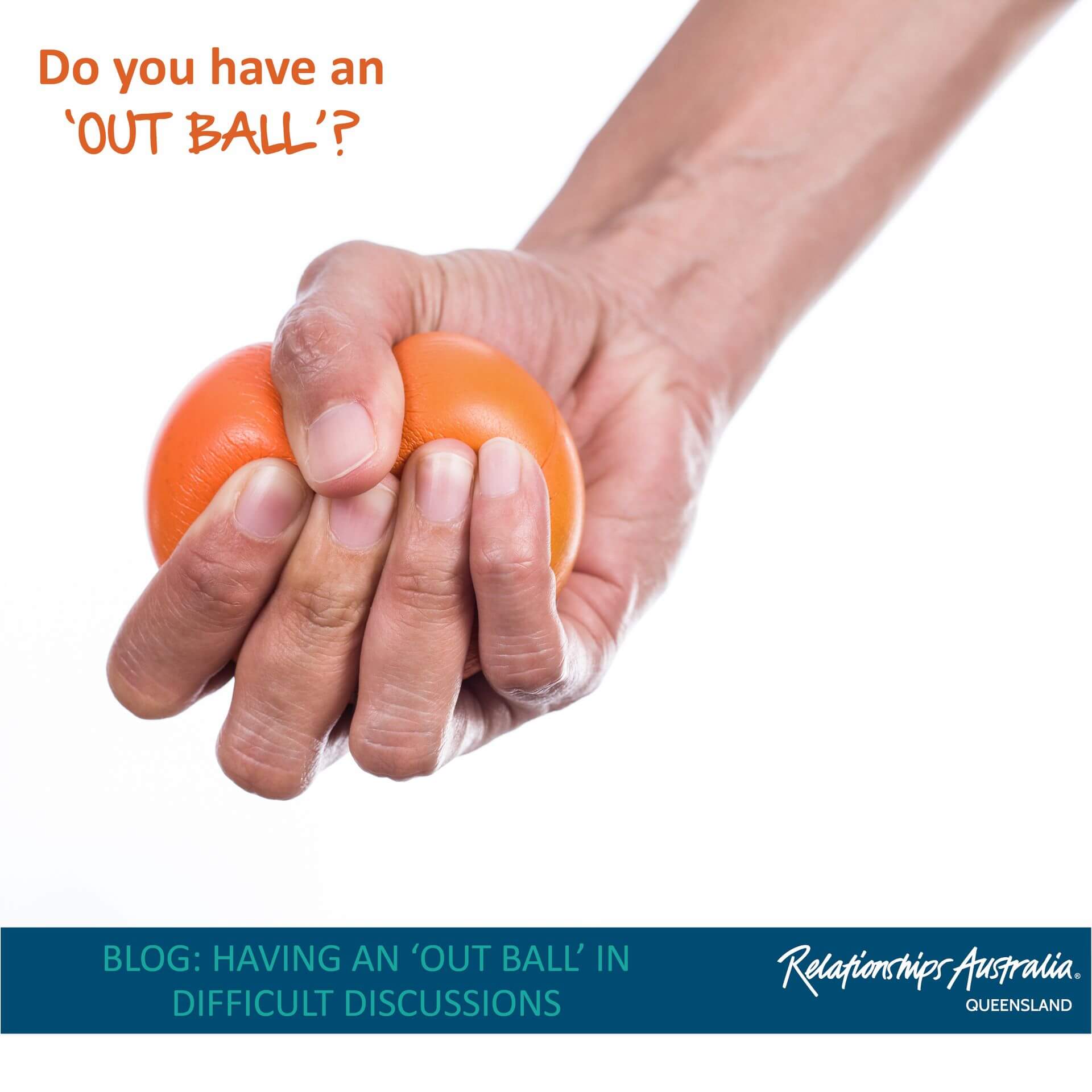
Having an ‘out ball’ for difficult conversations

Recently I needed an MRI. I’d suspected I could be claustrophobic, however it’s never been tested; until the MRI…..

A nurse greets me.

Do I want an eye mask?

No, I’ll just close my eyes.

I’m on a table with earplugs and earmuffs. I’m given an oblong ball to push, if I want to stop. Close my eyes. Deep breath. I’m ready.

The table moves into the machine. I feel it close around me. I have an immediate reaction and open my eyes.

“Are you okay?” she asks.

“Yep – but can you get me out?” I say with a surprising tremble. I’d started sweating. My heart was racing. I was panting through my nose, while pushing the end of the ball frantically.

She brings me out. I sit straight up. She sighs with empathy, reassuring me, normalising my reaction as one she understands. She says there’s little she can say that will make me feel differently. She suggests making another appointment where I’m sedated.

I ask how long the MRI (the tunnel of doom and terror) takes. Answer – 20 minutes.  

She suggests going in as far as I need to and straight back out to see how I feel. I agree. She also explains that the “out ball” is meant to be squeezed. I go in and out without incident.

Let’s do it; I can suck it up for 20 minutes.

I go through relaxation techniques I talk to clients about…visualisations…slow deep breaths. Mostly I reason with myself…it’s only 20 minutes, you have the out ball.

My lower arms are outside. Unexpectedly the table moves further in. I jump. My hands go up in panic. The nurse pats my hands, calming me down; saying she won’t move me anymore. I’m almost shuddering, my jaw is closed but trembling. A few involuntary whimpers escape.

I settle myself and refocus…”You’re okay….nothing is going to happen…relax.”

The machine does its thing. The nurse’s voice comes through a mike…”You’re doing really well. That’s the first one done. The second is about to start.”

“Just don’t move me!” I yell back twice.

Now and then the table feels like it’s moving. I feel I’m okay where I am, but terrified of moving further into the machine. I put the back of my hands on the outside of the machine to monitor this. Meanwhile reassuring myself if the table moves at all again, I’ll squeeze the out ball.   

I can’t swear on my life that the table moved, however, I’d reached the limit of what I could take; I was squeezing that ball in such rapid succession I should’ve been impressed.   

I was out….and a whole range of emotions followed. The experience affected me for days.

The MRI experience demonstrates being flooded with emotions. From that first emotional reaction I was no longer thinking clearly.

In my role as a Family Dispute Resolution Practitioner, I work with separated parents, who are sorting out the desolation of their relationship and time with children. This is emotional stuff without anything else. No wonder there are times that emotions are triggered or overwhelming. They’re human.

Wouldn’t it be nice to have an out ball? Something that identifies the parent wants out of this conversation, without any negative consequences.  

Parents (or anyone in a relationship) can agree to a word, which, when said, identifies they need to exit the conversation. Communication becomes problematic if either person is emotional or not prepared for the conversation. Importantly the ‘out ball’ word is activated PRIOR to emotions getting heightened and discussions can be attempted at another time.

Both need to know and agree with the “rules” for the out ball word. They don’t want to be pushing it instead of squeezing. J  


— Carolyn is a Family Dispute Resolution Practitioner @ Relationships Australia Qld

** If you could like help with making arrangements and agreements following separation, please call us on 1300 364 277 to discuss your options.

BE SOCIAL, SHARE!

If you enjoyed this blog, please share this blog by using the orange SHARE link at the top of the page. You can also subscribe to receive future blogs straight to your inbox (using the SUBSCRIBE box on the right).

What happens in Gambling Counselling?

For most Australians, gambling is an occasional and enjoyable recreational activity; however, for a small proportion of the community, gambling is associated with harm. Many people have heard that counselling can be helpful, but for some people, the thought of attending counselling is daunting.  So what happens in counselling and how can it help people experiencing problems with gambling? 

Counselling offers people an opportunity to consider what is happening in their life and what they would like to be happening.  Gambling Help counsellors talk with their clients to look at what is currently happening for them and consider changes they may wish to make.

A first session with a Gambling Help counsellor can occur either face to face or on the phone.  The counsellor will often invite a new client to explain what prompted them to seek help and what they are hoping will happen to improve the difficulties they are currently experiencing. 

Client and counsellor work together with the issues the client brings.  Counsellors don’t tell clients to stop gambling, or what to do.  The counsellor may guide a client, by asking some assessment questions to develop an understanding of how gambling is affecting the client’s emotional, social, relational, vocational and financial life. The counsellor may support the client to begin problem solving.  During sessions, client and counsellor may generate strategies which clients try out between sessions; and later, the client and counsellor review the new strategies. 

The issues and concerns which each person brings to counselling are unique, so what each person addresses in counselling will vary.  During counselling it is common for client and counsellor to work together to increase awareness of triggers for gambling and to consider ways to avoid these triggers or respond differently to triggers; To understand client motivations for gambling, and factors that support continuing and escalating gambling; To understand and address underlying issues linked to problem gambling; To explore the impact of their gambling on relationships with friends, family, work and other leisure pursuits and plan to make changes where there are concerns; And to manage and re-organise financial affairs.

Participation in counselling is voluntary, so counsellors and clients will have ongoing conversations about goals.  As clients gain skills and insight into managing gambling, participation in counselling generally becomes less frequent.  In the later stages of counselling, client and counsellor anticipate and plan for future risks, then when client and counsellor are ready, clients exit counselling.


— Julie, Gambling Help Counsellor @ Relationships Australia Qld

** If you are affected by gambling – whether it be your own gambling or the gambling of a loved one, please call our Gambling Help Service.

BE SOCIAL, SHARE!

This information may help someone you know. Please share this blog by using the orange SHARE link at the top of the page. You can also subscribe to receive future blogs straight to your inbox.
What is your love language?

Valentine’s Day is much celebrated in Australia and its popularity is increasing by the year. It’s an opportunity to strengthen bonds of love with partners, family, friends or those we secretly admire. This Valentine’s Day, as well as offering flowers and chocolates, try bringing other gifts to your relationship that can be appreciated throughout the year.

Dr Gary Chapman, directs us to the five love languages, as a way for us to connect with our partners and create long lasting, happy and stable relationships. Dr Chapman identifies the love languages as:

  • Gifts – loving through giving and receiving.
  • Acts of service – loving through doing things for your partner.
  • Words of affirmation – loving your partner by speaking positively.
  • Quality time – loving through valuing your partner and listening attentively.
  • Physical touch – loving through closeness and affection.

This might sound easy, but how do you identify your love language? Are you and your loved ones speaking the same love language? More often than not, we prefer to express our affection in different ways, which can lead to misunderstanding and conflict. When what we get differs from what we want, we fail to recognise that our partner is in fact expressing their love. By learning to speak and understand each other’s love language, we enrich our relationship, communicate our commitment and feel loved in return.

For more information about love languages, and how using the right one for your partner can help your relationship thrive, book to see a counsellor or visit http://www.5lovelanguages.com/, where you can take a quiz to find out your love language, or get more information about how to work out your child’s love language.


— Filiz Mortimer, Relationship Counsellor @ Relationships Australia Qld


BE SOCIAL, SHARE!

Many people are in a relationship, whether it be romantic or parental. This information may help someone you know. Please share this blog by using the orange SHARE link at the top of the page. You can also subscribe to receive future blogs straight to your inbox.
Family Systems can be Messy

Gone are the days where there is a married couple with kids, a cat, a dog and a mortgage. Where mum stays home and bakes while dad works a 9–5 job and is home to coach little Jimmy’s soccer team on Saturday. Nobody wanted to really know about the relationship between Aunt Mable and her lifelong friend Gayle who have lived and done everything together for 50 years. Shame on little Betty for getting herself knocked up out of wedlock, and divorce was something you didn’t do. “What an uncomplicated life,” some might say. Sounds a bit narrow minded to me…

I think it’s fair to say there is no longer a stereotypical traditional family system. I think there are lessened idealisation on what families should look like, and being in a messy family situation doesn’t need to result in damaged children.

I see children who take their family situations in their stride. “Mum is a lesbian and has a girlfriend and they’re having a baby together.” This 6yo even understands that they needed help creating the baby. He took the whole thing in his stride and to him it was as normal as getting dressed. Why? Because it had been presented to him as normal. This situation never caused him distress or discomfort, however the conflict between his separated parents was completely damaging.

My daughter and her friend were having a discussion at the tea table and mentioned someone being gay. I stopped and asked if she understood what being gay meant. She answered, “Yes. It’s when a man loves another man rather than a woman and a woman loves another woman.”

Hmm… What did she think about this? She stated confidently that it shouldn’t make any difference, they should be able to love whoever they want to love.

Big Tick. Mother (meaning me) has successfully installed appropriate value regarding gay and lesbian relationships in eldest daughter. But imagine that conversation happening 50 odd years ago.

I have seen extremely complicated family systems. One which included six parents, step siblings, half siblings and full siblings. One parent died which resulted in a child living and growing up in a household where she had no biological link to either parental figure, which she was not made aware of until age 16. These children are now adults, one has twins from an egg donor and fulltime care of her nephew with severe health issues. The parents of the twins are separated but still reside in the same house and support each other in parenting. All of the original children are partnered or married and (apart from one) have children of their own. They all class each other as siblings. They do not distinguish between half, step or full siblings they are simply siblings and all of their siblings’ children are nieces and nephews. They are all immensely close and spend regular time camping, touching base and supporting each other.

Messy family systems can still produce well-adjusted adults.


— Carolyn, Family Dispute Resolution Practitioner @ Relationships Australia Qld

** If you could like help with making arrangements and agreements following separation, please call us on 1300 364 277 to discuss your options.

BE SOCIAL, SHARE!

This post might help or reassure someone you know. Please share this blog by using the orange SHARE link at the top of the page. You can also subscribe to receive future blogs straight to your inbox.
I’m a Unicorn Mum… living with Autism Spectrum Disorder

Yesterday, I took Jack shopping. At the best of times, he finds these trips challenging. Jack is almost 5. Jack is an entertainer, he is funny, inquisitive, independent and loving. He has big brown eyes, wavy blonde hair and is so cheeky. This week he has a tiny pony tail at the front of his head. He tells me that he is a Unicorn….who also happens to carry a light sabre and wears gum boots. So I guess he’s a “bad ass” Unicorn.

Last year, just after his 4th birthday, Jack was diagnosed with ASD with a side of sensory processing disorder. Jack is what is classed as “high functioning”. We knew for a while that there was something slightly “different” for our precious boy, but couldn’t quite put our finger on it.

Anyway, back to my story, I took Jack shopping. The shop was crowded, the music loud and the checkout line long. Overwhelmed, Jack put his hands over his ears and started yelling for everyone to be quiet. An older lady, tut tutted and muttered something about Jack being bad mannered. I felt angry, flushed and beyond frustrated. I could feel the hurt, embarrassment, shame and sadness rising into an anger that was almost at the point of escaping. I pictured myself yelling right in the woman’s face  “stop judging us you ignorant person” (probably amongst other words less suitable for publishing). Instead though, to my shame, I ignored her, took Jack out of the trolley and left the shop….sans groceries.  I cried all the way out of the shop. I cried in the car park. All the while Jack was saying “Mummy, you sad, you sad, you sad?? Why sad?” When I strapped Jack into his seat, he reached out and wiped my tears and said “You are good girl Mummy. I love you”. I totally lost it. How could I tell him how ashamed I was of myself for not telling the woman to shut up? That my heart was hurting for him? That I felt I’d let him and me down again? That as a mum I’d been measured by that woman (and worse still, by me) and found lacking?

I decided, I had a decision to make. I could either continue to hurt and feel shame.  I could lash out in anger. Or, I could write a bit about my experience as Mum. My hope is that it may give you a different perspective, a different lens. My hope is that we are not judged in the supermarket and  that you don’t buy into the autism myths.  My real hope though, is that my Jack’s (and other kids) difference is celebrated and embraced.  

Before I get started, let me be clear, my experience is unique and I don’t speak on behalf of any other parent. That would not only be arrogant, but, pretty foolish too.  ASD is a spectrum. My son is unique, I’m unique, and so is my family’s experience.

I’ve listened to all the well intentioned advice from people who do not have children with ASD. The same people who feel compelled to tell me all about parenting a child with ASD, and about ASD.  Can I just tell you, that unless you’ve walked in my shoes, I really don’t want to hear it unless I’ve asked you. I’ve heard all the ASD and parenting “truths”, now let me tell you mine.

I feel that I consistently battle the so called “parental causes” of ASD that society, face to face or in “blogshpere”, feel the need to heap on me.  I think now, 12 months after his diagnosis, I’ve heard or read just about all of them. Some of these “truths” go as follows: Jack has autism because I didn’t hug him enough, I’m an older mum, I went back to work when he was under 12 months, I ate the wrong foods when I was pregnant, I didn’t manage stress when I was pregnant, I am a confessed hair product junkie who can’t walk past a new hair product (ok, so I added that one). Oh, and, don’t get me started on the whole vaccination causes autism debate. I don’t give a crap, and it doesn’t change the fact that my son has autism (thanks for the added guilt though).

Mostly, I try to let these myths wash over me and disregard them for the folly that they are. At times, I’ll counter the argument, others I’ll just zone out. My head knows that these “reasons” don’t have any truth to them, yet my heart at times takes over and I question myself…..”If you had done anything differently, would Jack have ASD?” “Did you do this?” I try not to go there, as the sadness and guilt is awful. It’s a dark overwhelming place, and it wastes the energy I could use in supporting my kids.

I cry more than you’ll ever know. I cry when I see my beautiful boy trying to fit in and relate to other kids. I cry when I see him try so hard to “fit in” and be rejected. Just recently he was trying to join in with some kids.  He’d been chasing them, and they were running away to avoid him. Not that he noticed, he thought they were playing with him.  They then slowed tiring of it and started to walk. Jack pulled out one of his “joining” tactics.   He’d spied something he thought was amazing. He yelled out to them “hey rock, a rock, look a rock”, the kids turned, looked at each other and said “yeah a rock, ooooh exciting. Who cares? Just a dumb rock and you’re dumb too” then ran off. My son was left standing there, not understanding what just happened, mesmerised by his rock. And his Mummy’s heart was breaking that little bit more.

At times like this (or like the supermarket example), I fight an overwhelmingly protective urge to scoop him up in my arms and run away with him to a place where I can make everything better. Where people see the bright, funny, loving, sensitive, quirky boy that is Jack. Where his “difference” is celebrated rather than judged. Where he doesn’t need to “fit” he just “is”.

I feel guilt for his sister, and that often my attention is diverted. This guilt is not helped by well-meaning people who point out to me the impact that having a brother with additional needs has upon her. Nor the lectures on “how I should make sure that spend more time with her, or do special activities with her”. I’m totally aware of this. I know the statistics that show a potential for poorer mental health outcomes for children with siblings with additional needs.  He has the most beautiful big sister who loves him intensely. Their close relationship warms my heart. I actively carve out time, just for her and I, special time to do “mother and daughter” things. Yet, I still feel like I’m never doing enough and “advice” around how to manage my relationship with her isn’t needed or wanted.

I’m so damned tired. Did you know that up to 80% of children who have ASD have poor sleeping habits? I don’t think Jack has had a full night’s sleep in over 12 months. Gets tough at times trying to work full time, do all the “Mum” things, let alone try and fit in “me” time. At times, when I could go out, I just don’t have the energy to do it. I’d rather just rest.

Oh, and I don’t care about how your mothers sisters uncles cousin twice removed “cured” their child from autism with a kooky diet. Yes I’m aware that diet can impact upon my son’s behaviour, and yes, I know what foods can trigger a behavioural response. No, I’m not putting him on your kooky diet of grass, bone broth and air!

While I’m at it, Jack doesn’t need more discipline. He is NOT going to “grow out of it”. He does not have savant abilities like Rain man, which, by the way, is such a poor stereotype for ASD. Anyway don’t you think, if this were true, and all kids with ASD were also savants, I’d be with all the other parents of children with ASD who followed Tom Cruises path, booked a trip to Las Vegas and be writing this from my own island in the Carribbean.

No, there is no “autism epidemic” nor are “Dr’s just giving out diagnoses willy-nilly to families”. Seriously? Yes there are more children diagnosed than say 20 years ago, but then medically and scientifically we’ve come a long way. We know more, have learnt more, and can identify signs of ASD more readily than we could have prior to the growth of research and development in the area.  I don’t hear of many people being diagnosed with “distemper” these days…say whaaaaaaat?

And, for the record, ASD is NOT an emotional, behavioural or mental health disorder. ASD is a developmental disorder which is biological in nature. That’s not to say that some kids with ASD don’t have additional needs, but, ASD occurs when the brain doesn’t develop in a “typical” way. End. Of. Story.

Finally, I’m torn. I love my son with all my heart and I’m glad that we have a name for the condition that is part of Jack. With this name, this label, we can then match the right supports for him. Yet, I don’t want this for him. I don’t’ want the extra struggle he is having and will continue to have to “fit in” to societal expectations. I see the way he struggles to “get” his peers, to “get” the social rules, to understand that the world and people cannot be processed within a literal framework. Yet, I celebrate his difference. He amazes me on a daily basis. I see that he has skills and abilities unique to him. I learn so much from him and his perspective on the world. I love Jack in is his entirety for the phenomenal boy he is. ASD is part of Jack, not Jack. My Jack is unique, like the mythical creature that he’s getting around as this week. He is my unicorn. Taking one element away would alter Jack, and I can honestly say, I wouldn’t want that for a second. 

Postscript

I am so eternally grateful for the amazing supports out there for parents like me. My family and I are so blessed to have linked with awesome organisations like Autism Queensland, Community Health, the Umbrella network, Education Qlds Early Childhood Development unit and other health and education professionals along the way.  Through these organisations, I’ve had the privilege to meet parents like me who’ve so generously shared their stories and helped me see that I’m not alone. Finally, special mention needs to be made of Jack’s grandparents. Jack is so incredibly lucky to have two sets of grandparents that love him unconditionally and continue to support him (and me) on our journey. We love you heaps xxxx 


BE SOCIAL, SHARE!

This information may help someone you know. Please share this blog by using the orange SHARE link at the top of the page. You can also subscribe to receive future blogs straight to your inbox.
 

Pornography and its effect on your relationship

There are many different views on this – some say it can enhance the relationship, while others say it is very detrimental and can (and does) break up relationships. In fact, both can be true. Pornography used as a sexual tool can enhance a sexual relationship between couples and if this is acceptable to both parties in their relationship, that’s fine.  Sometimes though one partner may use pornography more and more.  Research shows that watching pornography can have an ability to become addictive and where this may be the case the other partner may feel left out, betrayed, lied to and not as good as the people portrayed in pornography.

Why is it addictive and why does it seem to affect males more than females? Dr. Bill Struthers sheds more light on this as he explains the neurochemistry of sexual arousal, identifying the hormones and neurotransmitters at play in the wiring of male brains, specifically when it comes to sexuality. Dr. Struthers is an associate professor of Psychology at Wheaton College. He is the author of Wired For Intimacy: How Pornography Hijacks the Male Brain.

According to Dr Struthers, norepinephrine, serotonin, and dopamine all play a part in male sexual arousal, along with the male hormone, testosterone. Testosterone is a gonadal hormone (produced in the testis) involved in many processes in the body. One of them is the male sexual drive. Testosterone drives a man’s interest in sex. Mentally fantasising triggers a reflexive response in the body to release testosterone, and the more one does this, the “wave” of testosterone continues to build. Men experience this as an intense and growing desire for sexual release.

This wave of testosterone will occur if a man is thinking about or interacting with his wife, but it also happens when a man is staring at other women or a pornographic image.

This all sounds very logical and understandable but when clients come into my office at the point of breakup over porn addiction, me explaining this only goes so far. Try explaining this to a woman who has just found her partner masturbating over very explicit images of naked women.

Women state, “It’s like porn is his mistress”, ” I feel like he is having an affair with porn”, “I feel betrayed”. This is because it affects women in their emotions, the core of their being, and wounds them so deeply. Women want to be loved, accepted, desired, respected and being with a man who uses porn as his sexual arousal feels like the ultimate betrayal. Add to this that a woman may feel she can never compete with the porn images of women who have the best bodies along with the fact that her partner may begin to lie to her about how often he accesses porn. Then say to the woman who is feeling all this that it is his addiction and not about her! Of course it is about her; she is hurt, betrayed, left feeling utterly devastated. To a relationship this often spells disaster.

Can relationships come back from this and can couples rebuild what they had before? No, you can never go back, only forward – so you need to rebuild a new relationship. Firstly you both have to want this relationship and be prepared to make it work whatever the cost.

For the male, he needs to understand the devastating effect porn has had on the relationship and be prepared to seek help and give up watching porn.

For the female, she needs to find, somewhere inside herself, the ability or desire to be able to forgive and be prepared to attempt to trust again.

This takes time and an experienced relationship counsellor can help you both understand the steps which need to take place for this rebuilding to start. Don’t try and do it on your own. There is so much hurt and defensiveness and you need to both be held and helped through this difficult process. Call us on 1300 364 277 for more information or to make an appointment with one of our counsellors—they are experienced and able to help.

— Val, Relationship and Family Counsellor @ Relationships Australia Qld


BE SOCIAL, SHARE!

This information may help someone you know. Please share this blog by using the orange SHARE link at the top of the page. You can also subscribe to receive future blogs straight to your inbox.
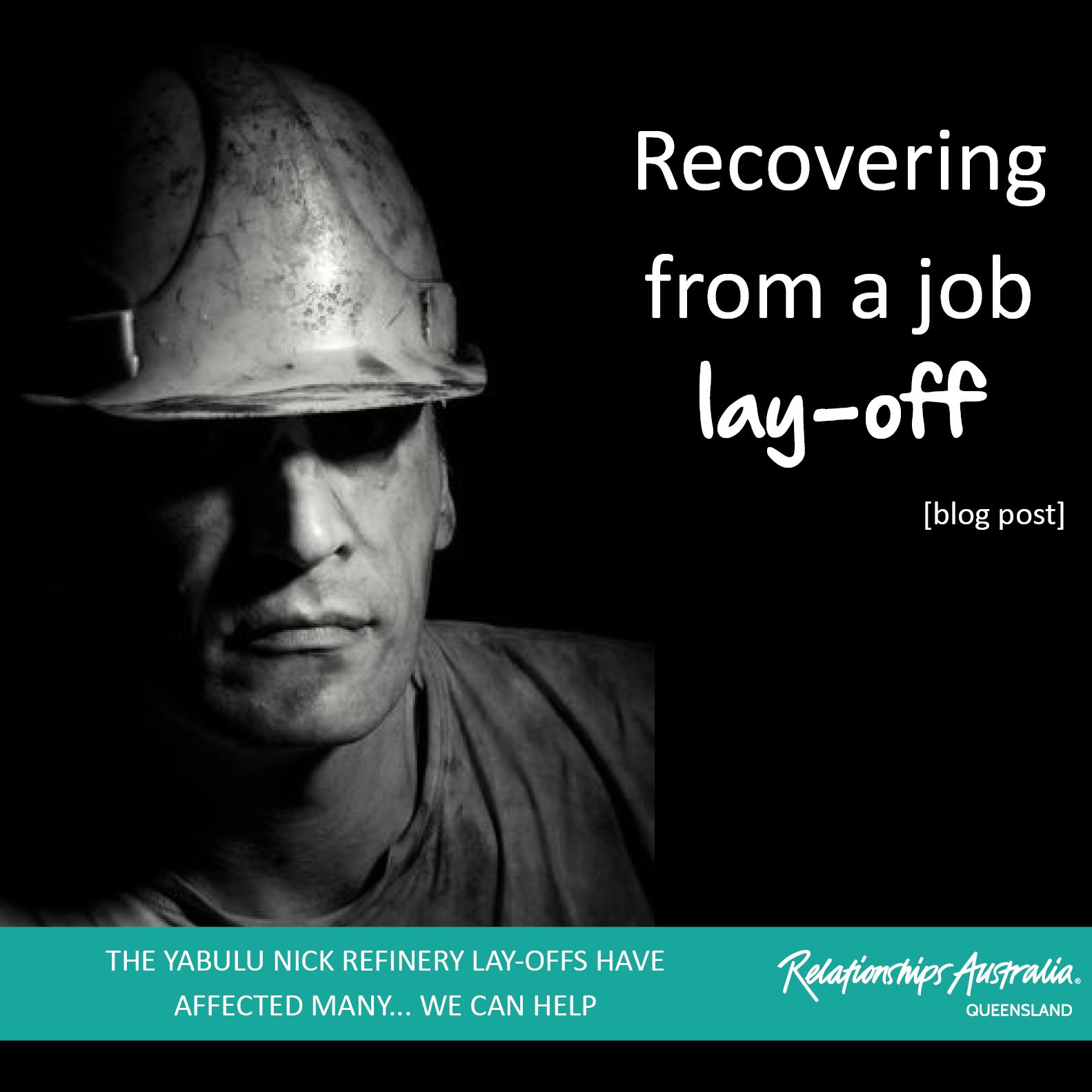
Recovering from a job lay-off… Thoughts about the Yabulu Nickel Refinery.

With the recent Yabulu Nickel Refinery lay-offs, many members of our Townsville community are affected—with retrenched workers facing an uncertain future and worry, or even panic, about their family’s financial situation.

The pressures and insecurity facing these miners will be familiar to anyone who has been unexpectedly laid off, retrenched, or ‘made redundant’ from their job… and in addition to the financial impacts, we understand that the emotional consequences of job loss can also be extremely difficult.

The resulting stress of redundancy can tip a pretty healthy and functional relationship into one which is in trouble, and while these relationship issues tend to be after-effects, noticed long after the initial financial impacts are felt, they are extremely important to consider and address.

If you are facing redundancy, we encourage you to pay close attention to your relationship, and be reassured that there are several organisations, including Relationships Australia, who offer emotional support, counselling, and practical solutions for the range of impacts you may be facing. It’s important to know that Relationships Australia also offers fee reduction possibilities for clients facing financial hardship.

If you have been laid-off, we understand the full range of worries you may be having and seek to support you with decision-making, planning, and working through the complex range of emotions which may arise during this difficult time.

Examples of early worries:

  • How will we pay our bills?
  • Will we have to move house?
  • Will the kids be able to stay in private school?
  • Where will I find another job (especially when 237 others are also looking for work)
  • Will we have to relocate to another town?
  • Will we lose our private health insurance?  What about my super? 

This can be exacerbated in cases of large lay-offs, as the ability to find other work or sell a house is threatened by the situation when lots of others are in the same boat. 

When you attend counselling, we can help you plan how to best cope with the financial uncertainty these situations cause. 

Issues which can surface once the shock is over:

  • Existential worries, such, as ‘How can I be a good parent/partner if I can’t provide for my kids/partner?’
  • Embarrassment over the decrease in income and how it affects one’s lifestyle (no more great vacations, have to downgrade to a cheaper car, etc.)
  • Embarrassment at an inability to pay outstanding bills in a timely manner
  • The need to defer routine things formerly taken for granted, such as medical and dental visits, car servicing, etc. 
  • Stress associated with maxing out available credit to make ends meet.

These sorts of issues are common among those affected by job layoffs, and are best addressed in individual and couples counselling.  As it can be difficult to access counselling during times of hardship, Relationships Australia (Qld) offers fee reduction for families with financial hardship.

Impact of job loss on the individual directly affected may include:

  • Loss of self-esteem (can’t provide for the family, especially if the skill isn’t transferable to another job)
  • Depression and anxiety
  • Anger over the circumstances of the lay-off
  • Decreased motivation
  • Increase in unhealthy coping strategies including increased use of alcohol, drugs and gambling
  • Loss of self-confidence and sense of self-worth
  • These impacts may be heightened with older workers who may be less employable than their younger counterparts.

Stress, depression and anxiety are common following unexpected job layoffs.  Although your GP should be consulted in significant cases of depression or anxiety, many people find that counselling can also be very beneficial.  Trained counsellors can help develop better coping strategies which can assist in alleviating some of these symptoms.

Impact on the spouse/partner:

  • May have to find a job, increase hours, or work two jobs to help out financially
  • May resent the added pressure to help out, or the decreased time to focus on things previously important to him/her
  • May feel distance from the partner which contributes to relationship tensions
  • May resent having to relocate to another town. 

Partners are in a unique situation, as they typically want to support and assist the person laid off, but may have their own set of individual worries and stresses.  Individual counselling can often be helpful, and often is a short term rather than long term need. 

Impact on the couple:

  • Increase in stress and tension in the relationship
  • More fighting, less sex, less ‘fun time’
  • Less money to go out on ‘date nights’
  • Unfairly placing blame on the other person (‘If you had been a better employee you wouldn’t have been one of the ones laid off’)

Relationships are difficult under the best of circumstances, and stresses such as job loss can really complicate even an otherwise stable relationship.  Early intervention with couples counselling can be an essential part of the strategy to manage during such a stressful time. 

Impact on the kids:

  • Depending on their age and how much they know about the situation, they may have worries about what it means for them as a family.  Can Johnny still play footy?  Can Susie still take ballet?  Can they still go out for dinner every Friday night? 
  • Distress at seeing conflict between parents.
  • Generalised anxiety about what this job loss will mean to them individually as well as the family.

Services for the children, or for the family as a whole include family counselling, counselling for kids, and case management serves for families who are struggling as a whole.  It is important not to underestimate the impact on children of any age.   


If you have experienced hardship, loss, or struggle in any situation, we are here to help. Our programs cover a wide range of issues, and if there is a situation in which we cannot assist, we will do our best to direct you to someone who can. Please call us on 1300 364 277 for more information or to make a booking to talk with a counsellor.


New website to support those living with chronic illness

Relationships Australia (National) recently launched a new website, www.humankind-relationships.com.au to support people living with chronic illness and their loved ones to achieve positive and respectful relationships.
Humankind provides relationship information, support and resources appropriate for people living with a chronic illness and for the families, friends and practitioners that support them. 

“All couples experience hard times, though living with a chronic illness or with a partner who is chronically ill can have a dramatic impact on your relationship,” Alison Brook, National Executive Officer Relationships Australia said. 
“When dealing with chronic illness relationship issues are often overlooked, however the research tells us that good relationship health is fundamental to overall wellbeing. Working to improve your most important relationships can lead to better health outcomes. This is what the Humankind website aims to help people do,” Ms. Brook said.

The name Humankind comes from the notion that it is human to experience chronic illness and it is natural for humans to want to help each other when times are tough.  Being kind is the corner stone to healthy and long lasting relationships.  The message from Humankind is to be kind to yourself and others.

Humankind was developed by Relationships Australia with the assistance of a Health Access Grant from Medtronic, a global leader in medical technology.


Conflict… Start the new year with a challenge to manage it well.

written by Jude, Family Dispute Resolution Practitioner and Relationship Counsellor @ Relationships Australia Qld

Conflict is invariably seen as negative and therefore has the power to become destructive. But conflict can be positive if handled thoughtfully. For this to happen each person needs to accept responsibility for resolution. We only have three choices in life – put up with things the way they are; make changes that give a greater level of satisfaction; or walk away.  Sometimes this can be a difficult choice especially when the conflict is within an intimate relationship.

In the main there are four things that have the potential to light the fuse.

  1. In most arguments each person insists that they are right.  This of course means that someone has to be wrong.  I wonder who becomes the umpire.
  2. Not listening and not engaging displays arrogance, disinterest and disrespect.  Resolving conflict requires a commitment to move forward and therefore it requires attention and intention and an acknowledgement that it takes at least two people to continue to battle.
  3. When we judge another person or assume we know what they want; what they feel or what they are thinking, there is an essence of superiority.  “I know more about it than you”,  “You know you don’t like going to the beach”,  waves a red flag.
  4. Unresolved conflict will escalate when aggression moves to anger and rage.  Similarly passive behavior, “Whatever you want”, will also ensure the problem remains a problem.  Assertiveness lets the other person know how you feel, what you would like if it is said with respect.

So, there are a few things that can become indelible and remain in our unconscious competence when faced with a conflictual situation.

  • BE CURIOUS NOT FURIOUS.  Rage and fury escalate conflict – being curious leads to solving the problem. “How do you think we could approach this?”, Are you feeling OK to talk?”, “I can see you are upset, what do you need right now?”. Curiosity increases understanding, helps to engage the other person, gathers information, focuses on feelings and demonstrates hope.
  • DELETE FROM THE VOCABULARY words like always, never, just and do not start sentences with the judgement word you, “You always carry on like this.”.
  • FOCUS ON THE BEHAVIOUR which raised the blood pressure, not on the person. This means being aware of body language. It is amazing how a raised eyebrow or hands on hips can be seen as provocation. Keeping the conversation about behaviour reduces the emotion which reduces the tension.
  • BE HONEST AND HUMBLE.  This goes a long way. Owning up to a mistake, not justifying or defending or blaming can sometimes stop an argument in its tracks.
  • ACKNOWLEDGE THE EFFECT your behaviour has on the recipient and validate the feeling it creates. If you accidentally step on someone’s foot their pain is the same as if you did it on purpose.

Very few conflicts come without warning. Many years ago an Oprah Winfrey episode described how easily conflict can escalate.  This is how it went: We can often get a whisper of something unsettling. If unheeded this whisper becomes a message. If not addressed this message becomes a problem which has the potential to become a crisis or even a disaster.

How true the old cliché is – we cannot change someone else, and we cannot change the past, but we can always change our attitude.

— Jude, Family Dispute Resolution Practitioner and Relationship Counsellor @ Relationships Australia Qld


BE SOCIAL, SHARE!

This information may help someone you know. Please share this blog by using the orange SHARE link at the top of the page. You can also subscribe to receive future blogs straight to your inbox.
 

Communication Short Circuit

Communication is one of those things which we all do in one way or another. There are literally hundreds of ways in which communication can be misunderstood or misinterpreted. In the land of simplicity, when we communicate one person sends a message and the other person receives it; doesn’t seem that hard, does it? 

I have worked as a mediator and in the field of dispute resolution/conflict management for around 17 years, so I consider myself one pretty aware communicator; essentially communication is the core of my job. Yet I received a wakeup call, a reminder of just how fragile communication is.

We have a one year old daughter whose baby sitter is going overseas. Obviously we needed someone and decided that my husband would take leave and stay at home. I checked the dates and told him that he would need to take from the 16th Feb until the 2nd March off. His work needs 2 months’ notice so late November my hubby’s leave was approved. Right, that’s organised.

Then a very confusing conversation developed where my hubby explains that the boss wants him to work away from the 6th until the 16th of Feb. I ask if he’ll be back before I leave for work on the 16th. It gets very confusing from this point and I feel completely lost as we both try to make sense of what the other is on about. I’m definitely missing something. Clarity chimes as he finally says “I thought the 16th was my last day of work and my first day home is the 17th.”

What! How on earth could he think that? How could he have possibly gotten that out of what I’d said? “I said you’ll need to take from the 16th Feb until the 2nd March off,” I repeat to him. What was unclear about that?

More confusion. He explains that he thought I meant that the 16th would be his last day of work before his leave and then the 2nd would be his first day back at work after his leave.

I’m completely beside myself with disbelief. How could he not have known what I meant? It was totally clear and obvious, wasn’t it? Anyone would have known what I meant; after all I’m a clear communicator, aren’t I? When I’d gotten over myself, I considered this. 

It is definitely evident that the message I had sent was not received or interpreted in the same way. There had been an assumption, a short circuit, and it had happened so easily.

My husband and I were working together towards the same goal. Imagine if we weren’t; if we were separated parents and communication was tense and difficult to start with. Luckily, we’re on the same team and definitely not adversaries. Yet this one simple short circuit caused incredible confusion and took time to work out what we both meant because of our different understanding from that one comment of mine. Yep, communication appears easy but is easily short circuited.

Oh and we have someone to look after our little girl.   


— Carolyn is a Family Dispute Resolution Practitioner @ Relationships Australia Qld

** If you could like help with making arrangements and agreements following separation, or any other issue which requires support, please call us on 1300 364 277 to discuss your options.

BE SOCIAL, SHARE!

If you enjoyed this blog, please share this blog by using the orange SHARE link at the top of the page. You can also subscribe to receive future blogs straight to your inbox.